
Coast - Eyemouth to John O'Groats
This section of the coastal tour takes in the east coast of Scotland. Sweeping through the south to Edinburgh. Then the fishing ports of the Firth Of Forth. The home of golf at St Andrews. Then smokies in Arbroath, the granite city of Aberdeen and craggy coastlines leading to John O'Groats.
Clicking location names highlighted in bold purple will open a new page with more detailed information
Prices quoted are correct as of May 2026
Clicking location names highlighted in bold purple will open a new page with more detailed information
Prices quoted are correct as of May 2026
Previous: Skegness - Berwick Next: Dunnet - Gretna
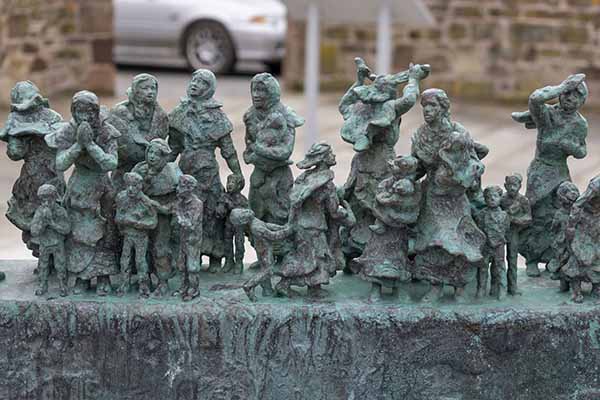 The initial drive into Eyemouth could, at best, be described as uninspiring as it passes through new housing estates and past caravan parks but persevere and you will reach the delightful old town with its still very active fishing port.
Mainly a white fish port with some crabs, prawns and lobsters and although herring is no longer a major catch, there is a week long herring festival held every July. The museum tells the towns story from 1298 and it includes a tapestry to commemorate 189 fishermen who perished in a ferocious storm in 1881. This disaster is also remembered with a poignant sculpture near the harbour. An informative town trail will show you some of the more infamous buildings, including a mansion which was the headquarters of the local smugglers.
St Abbs has a row of neat cottages overlooking a small harbour, which is the base for fishing trips for divers who wish to explore the nearby marine nature reserve. Nearby is St Abb's Head, home to some 50,000 odd sea birds. In summer several species of butterfly can be found making the most of the profusion of wild flowers. The top of the head, on a clear day, offers stunning views.
Pease Bay is a cove surrounded by large red cliffs but it is the surrounding woodland which is the major attraction. Pease Dene is a wildlife reserve with sun-dappled pathways with meandering streams, the noise of the stream competing with the pecking of woodpeckers. In spring and summer the reserve is carpeted in wild flowers.
Dunbar can trace its history back to Iron Age times with relics on display in the towns museum. Most of the buildings date from the 18th and 19th century. Some of the buildings around Victoria Harbour have been restored and there is also a lifeboat museum.
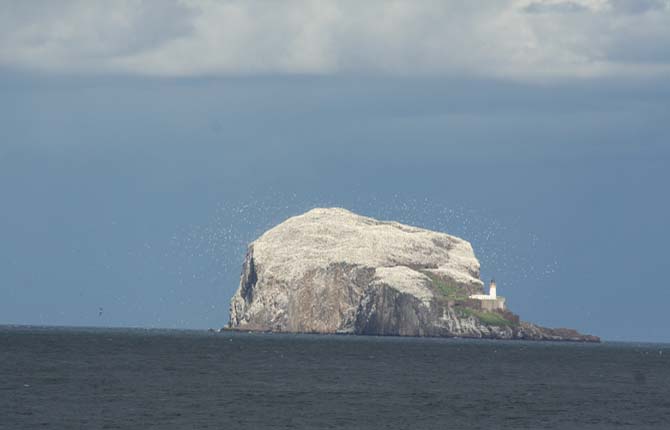 North Berwick is a popular golfing destination but it is also famous for the Scottish Seabird Centre where remote cameras show you the action from nearby Fidra and Bass Rock, the latter being known for the colony of gannets, so large in numbers they make the former volcano appear to be white. Open daily, admission: Adult £13.50, Concessions £11.25, Children £9.00
A few miles inland, at East Fortune airfield is the National Museum Of Flight where the star attraction is Concorde and visitors get the opportunity to walk round the very special aircraft. There are plenty of other exhibits covering all the eras of aviation and every July around 11,000 turn up for the annual airshow. Open daily Admission Adult £15.50, Concessions £12.50, Children £10.50 (discounts available for advance booking)
Despite being in Scotland Dirleton looks like the quintessential English village, set around a village green. Surrounded on three sides by delightful cottages the fourth side is bounded by the castle which is home to some delightful gardens.
Prestonpans, named after the nearby salt pans which used to run along the shoreline, is home to a 17th century market cross with a well preserved dovecote from the same era nearby.
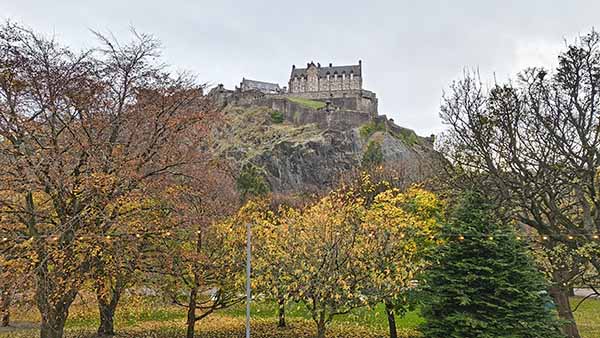 Edinburgh, as befits a capital city, has plenty of attractions on offer with more than enough to keep anyone occupied for several days.
Leith is the harbour of Edinburgh and is still an active harbour. Its main attraction is the former Royal Yacht Britannia, now open to the public. Open every day except Christmas Day and New Years Day. Admission: Adults £21.00, Children £10.50, concessions are available.
Queensferry at the end of the stunning Forth Bridges and the local museum tells the story of the bridges and the ferries that preceded them, as well as the history of the town.
Bo'ness was once Scotland's third most important port and the story of its maritime heritage is told at the Kinneil Museum, which is also the starting point for walks taking in the maritime history from Roman times. There is a separate walking trail available in the town itself. Nearby is the headquarters of the Scottish Railway Preservation Society, which has operating steam trains amongst its attractions.
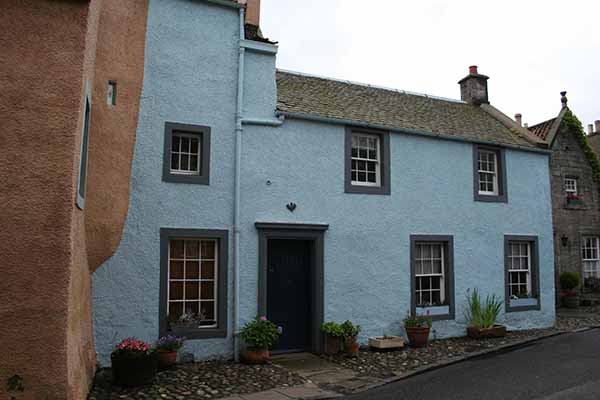 Culross was the centre of the coal and salt industries in the 16th and 17th centuries making it, at one time, the wealthiest town in Scotland. The days of industrialisation are long gone but many of the buildings have been restored to their 16th and 17th century glory and museums tell the story of the town. Much of the coal was shipped to the Low Countries and rather than return empty the ships often came back loaded with red pantiles, which were used to roof the houses in the town, giving the place a Dutch feel.
Charlestown is another town built round a village green, once a busy port exporting lime, the harbour is now a marina. Remains of limekilns can be found nearby.
Aberdour is a pleasant little resort, offering views across the Firth Of Forth towards Edinburgh Castle. The silver sand beach is popular with Edinburgh residents wanting a day by the water.
Kirkcaldy is a town with plenty of green spaces and each April is home to one of the biggest street fairs in Britain, the Links Market. Ravenscraig Park has a trail taking in woodland, cliffs and the seashore. Although a port, the towns greatest "exports" are, arguably, people with economist John Smith, architects Robert and James Adam and former Kirkcaldy schoolmaster, cum historian, Thomas Carlyle amongst them.
Wemyss, pronounced "weems" is a trio of towns consisting of Coaltown of Wemyss, East Wemyss and West Wemyss. the former being created to house local miners. The remains of the disused Michael Colliery remain at Easy Wemyss, the colliery was the site of a fire which claimed the lives of nine miners and a memorial to them is nearby. West Wemyss is home to a disused harbour.
St Monans was once a major shipbuilding port but now the harbour is home to a marina and a handful of shellfish fishing boats, with tourism the main attraction. The partly restored St Monans Windmill tells the story of local salt panning.
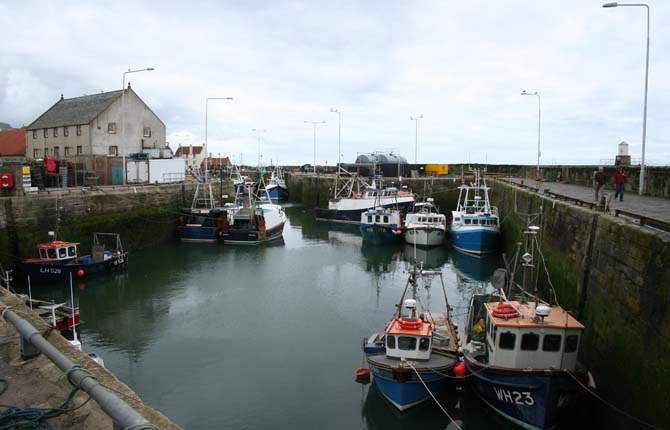 Pittenweem is still an active fishing port with a double harbour. Steep streets lead down to the harbour which has a popular fish market, open to the public.
Crail is a delightfully preserved fishing village, cared for with pride by local residents and the National Trust For Scotland. The museum in this unspoiled port tells its history and visitors can purchase freshly landed, crabs and lobsters. Nearby is Scotland's Secret Bunker, where the Government would have been based in the event of a nuclear war. Declassified in 1992 the complex is now open to the public daily March to October.
St Andrews is the home of golf with no fewer than six courses, including the world famous "Old Course". There is, however, more to the city than golf and expansive beaches can be found along with a harbour from where lobster fishermen still ply their trade. There are plenty of other attractions including the ruins of the 12th century cathedral, where the top of the tower offers stunning views of the city. St Andrew's University is the third largest in Britain. There is also an aquarium, a Victorian Botanic Garden and St Andrews Castle, dating from 1200, with its forbidding dungeon. Two miles away is Craigtoun Country Park, which includes a Dutch-style model village.
The lives of Macbeth, Robert Bruce, John Knox, Charles II, Montrose and Cromwell, as well as many others, are all linked to Perth in some way or another. The city has been under siege seven times in its history and the theft of the Stone of Scone from the nearby palace soured Anglo / Scottish relations for many years. Little of the medieval city remains but there is plenty to see on the city that spans the River Tay. A word of warning though, I found Perth to be a very expensive city with some of its restaurants charging prices some London restaurants would be ashamed of.
Jute, jam and magazines are what Dundee is famous for, although the jute is no more and the jam only really relates to Dundee marmalade, the magazine trade is just about surviving nowadays. The city seems to have a disproportionately large docks but that is down to its importance as a major whaling centre, thankfully no more. If you're into gardens then the universities Botanical Gardens are a good way of whiling away an hour or two. There is a sweet factory which can be explored and for budding astronomers Dundee is home to Britain's only full-time public observatory. Discovery Point Visitor Centre is home to Discovery, the ship which took Captain Scott to the Antarctic along with the frigate Unicorn, believed to be Britain's oldest ship still afloat.
Carnoustie would probably a nondescript little town if it was not for its three famous golf courses. The War Memorial Gardens offer a blaze of colour in spring and summer.
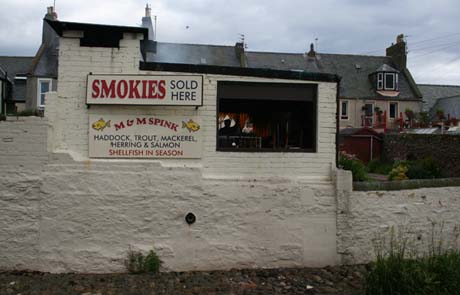 Arbroath is a small holiday resort, not particularly OTT, with a Miniature Railway being it's most white knuckle attraction, along with some stunning coastal walks. However the overwhelming claim to fame are the Arbroath Smokies, haddock cured over a beechwood fire. With several smokeries still in the town purchasing a smokie is easy, however for the ultimate experience you cannot beat visiting a smokerie and experiencing one straight from the kiln. Just north of the town is a delightful beach, fronted by a vast green open space. Auchmithie, a couple of miles north claims the smokie began there but, in truth, who really cares where they began - be thankful they exist. Auchmithie is worth a visit in its own right - no great attractions as such but a small harbour, a small beach and plenty of peace and quiet.
Montrose is a Georgian town with many splendours from that era remaining, unfortunately the most elegant looking of the lot, Montrose Academy, with its golden dome, is not open to the public. Montrose Basin, a natural but shallow harbour, virtually drains at low tide leaving some three square miles of mudflats, a delight for bird watchers. Just north of the town are four miles of sandy beaches. Near the top end of the beach is St Cyrus Nature Reserve, home to over 300 species of flowers.
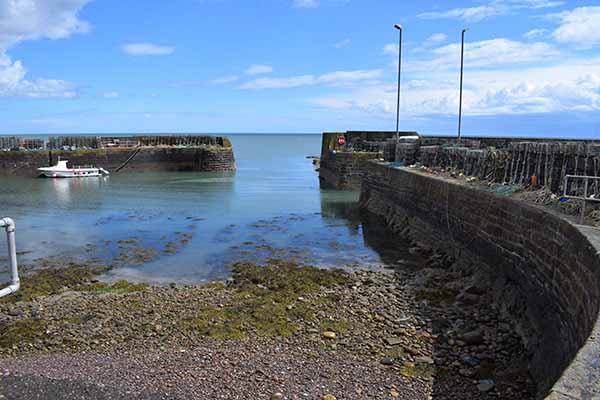 Johnshaven is a small fishing port where it is possible to buy lobsters and, seasonally, salmon. There is a four mile nature trail from the town, following the path of a disused railway line. It's a delightful little town and very non-touristy.
Gourdon is the last remaining Scottish port where the fishermen use 19th century trawling methods. Still a relatively busy port , visitors can purchase fish directly from the filleting sheds around the harbour. The town is set in an natural amphitheater as it is surrounded by steep, grassy, cliffs.
Catterline is a picturesque village where the cliffs are ablaze with colour from wild flowers in spring and summer. The village is atop the cliffs whilst a steep path leads down to the harbour. The village is popular with artists and bird watchers. Just to the north is Fowlsheugh RSPB Reserve, one of the biggest seabird colonies in the country. Centered around the largely abandoned village of Crawton a path leads to the cliffs where the birds are found. Visiting is not for the feint hearted. The path is not well marked and there are no barriers. Some visitors also find the sheer numbers of birds as well as the noise and, in particular, the smell of around 100,000 seabirds somewhat overwhelming.
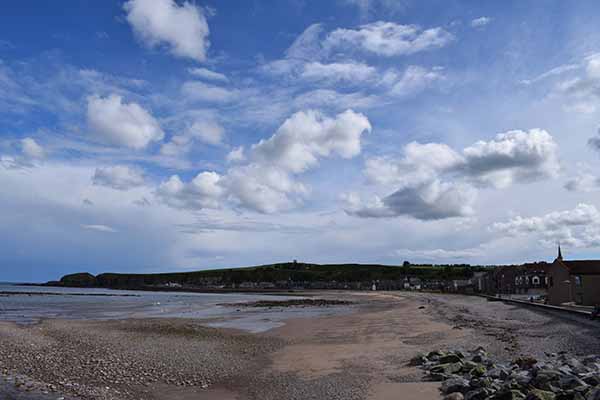 Stonehaven is a town of contrasts. The north end is a seaside resort with caravan parks, amusement arcades and a sweeping beach. The south end is a delightful, double harbour, fishing port, surrounded by an intimate, unspoiled fishing village. It's not a particularly glamourous resort and the buildings are a drab grey.
A path from the whitewashed town of Muchalls will take you to the coast which offers a number of small bays and looking north there are spectacular views of the coast including stacks and caves. Parking is limited but the stroll to the cliff tops is well worth it.
Portlethen is still a working lobster port however much of the local fishermen can no longer afford to live here as properties have been snapped up by Aberdeen commuters.
Aberdeen is the third largest city in Scotland and was given a new lease of life when it became the centre for the North Sea oil and gas industries. It isn't just gas and oil as Aberdeen is a resort in its own right as well as being a fishing and general port. It is also home to ferries going to Shetland and the Orkneys.
The 10 mile (16km) beach at Balmedie is backed by shifting sand dunes and the area has been described as a mini Sahara Desert, as the shape of the dunes constantly change. The sandy beach, one of the longest in Britain is, because of its massive size, generally very quiet and bathing is safe. A visitor centre provides plenty of information and there are plenty of marked walks in the dunes.
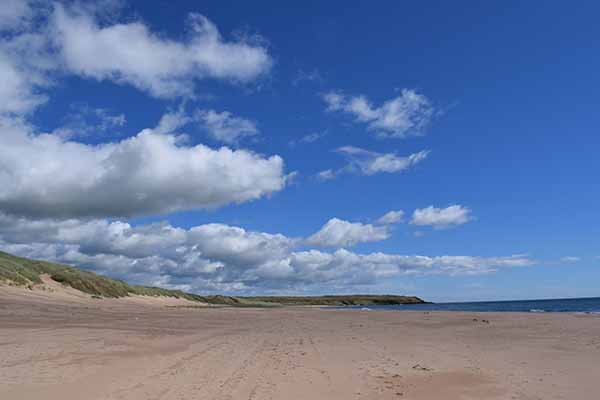 The Sands of Forvie, near Newburgh, are home to the largest dune system in Britain, with some dunes almost 200 feet (61m) high. The area is part of a nature reserve, some parts of which are closed during the nesting season to prevent visitors walking over the nests. Again marked walks, especially the 3.4m (5.5km) dunes trail gives you a taste of all the different environments.
The ruins of Slains Castle, near Cruden Bay, are said to have inspired Bram Stoker's Dracula. A small fishing port, the town was transformed by the arrival of the railway in 1897 and a massive hotel was built. The railway and hotel are both long gone but Cruden Bay remains a popular holiday and golfing destination.
Until 1893 Peterhead was Britain's premier whaling port, now it is a major North Sea oil supply base as well as still being home to a major fishing fleet of some 400 ships. Almost all the houses in the town are built of locally sourced pink granite. Needless to say purchasing fish, both fresh and smoked, is very easy in the town.
Rattray Head is one of the few areas along this stretch of coastline accessible by car. Only the ruins of the church remain of the village that was once here, although there is a lighthouse on the end of the head. There are coastal trails (on foot) available north and south of the head.
Second only to Peterhead in terms of fleet size, Fraserburgh is still a major fishing port. The lifeboat station at the harbour is open most days in the summer, apart from Sundays. The fish market is open weekday mornings from 07:30. There is a nearby sandy beach, backed by dunes.
There is some evidence of Rosehearty being a fishing port in Viking times but thriving fishing industry can be traced back to the 14th century. The narrow harbour entrance resulted in the bulk of the offshore fleet relocating to Fraserburgh and Peterhead but the port is still home to a sizable inshore fleet.
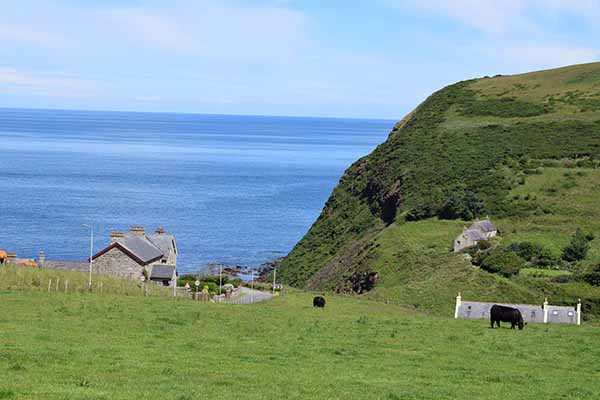 Pennan is home to the most famous red telephone box in the country after it featured in the film Local Hero, so important to the town it actually has a preservation order. A one street town it has a permanent population of around 25 and is overlooked by cliffs inhabited by noisy seabirds.
Banff is home to an eclectic mix of architectural styles, whist the churchyard of the now derelict St Mary's church has many impressive tombstones. Duff House is home to an impressive collection of art, part of the National Galleries Of Scotland
Cullen is a delightful resort and home to a somewhat challenging "split level" golf course. The town is also the origin of the excellent Cullen Skink, a smoked haddock based soup. Finding Cullen Skink itself is a challenge in the town but most of the neighbouring towns do sell it, all claiming to have the best.
Portknockie, once a fishing village, is now a home to pleasure craft. A walk down from the village atop the cliffs takes you to a small bay with caves and interesting rock formations.
Buckie has a 2½ mile long beach and is one of the few Scottish ports where fishing boats are still built. It still has its own fishing fleet, catching mainly shellfish. The daily fish market is busiest on Thursday and Friday. In summer boat trips are available to go dolphin watching.
Spey Bay was once a major salmon fishing port but those days are long gone. Individual fishermen are attracted to the town to pit their wits with the local salmon. An old warehouse in the town has been converted into a Whale and Dolphin Conservation Society exhibition.
Lossiemouth offers great views over Spey Bay and is very popular with anglers. There is still a thriving fishing port with a fish market each weekday morning. The town itself is delightful and well worth exploring on foot.
Findhorn's port is now used for watersports and sailing but it is the local wildlife which is the biggest attraction. Both grey and common seals live in the bay and the extensive mud flats attract migrating birds. Nearby are seven miles of sandy beach with sand dunes.
Nairn was once a prosperous herring port but is now a base for lesiure craft instead. The history of the town goes back to the 12th century and is told in the town museum.
Culloden Moor is the site of the last battle to have been fought on British soil. A visitor centre tells the story and guided walks of the moor are available in the summer.
Inverness, at the end of Loch Ness, home of the eponymous monster, is the unofficial capital of the Highlands. I have to admit I found it a generally uninspiring place, adequate for an overnight stop but little more. A drive along the Loch is well worthwhile though.
Avoch, pronounced "Ock" sees cottages grouped around the harbour. Many of the locals descend from Spaniards wrecked on the shore after the defeat of the Armada.
Cromarty will be a name familiar to anyone who has listened to the Shipping Forecast on the radio. The large natural harbour, Cromarty Firth, was used by the Royal Navy in both World Wars. The town is a delight for architecture lovers with may 18th and 19th century buildings surviving or having been restored. Dolphin watching boat trips are available from the harbour.
Conon Bridge is a place of interest to anglers with both salmon and seat trout in plentiful supply.
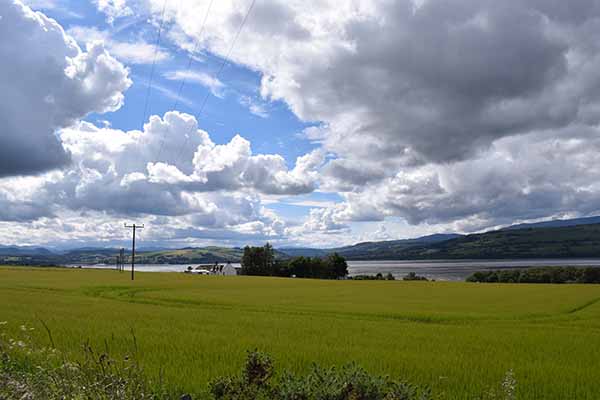 At the Top end" of Cromarty Firth is Dingwall, the administrative capital of the area. There has been a settlement here since Viking times and is now a thriving market town and the cattle sales location for the area. The Town House contains a museum whilst next door is the towns oldest building, a former school house dating back to 1650. The Harbour has long silted up but the remaining mudflats are home to many seabirds and migrators.
Invergordon probably would not merit much of a mention were it not home to a major complex which refits and maintains oil rigs.
Portmahomack is a small village but the bay is popular with windsurfers.
Coal mining was once the mainstay of Brora but now it is an amber liquid for which the town is known as a distinctive single malt whisky is produced here. Bird and seal watching is possible from the south of the harbour mouth, whilst to the north is a mile long sandy beach. There is good salmon and trout fishing available and nearby Loch Brora offers some delightful waterside walks.
Laidhay Croft Museum features a restored thatched long-house housing a museum of local life, giving a good impression of life as a crofter.
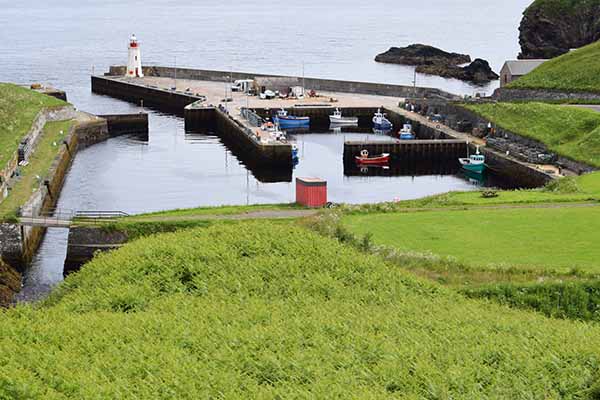 There are plenty of small harbours around the Scottish coast but one of the most beautiful has to be Lybster. At the end of a grassy creek the small harbour, unbelievably home to 350 boats in its heyday, was the third largest fishing port in Scotland. Now it's home to just a small handful. Waterline, on the edge of the harbour tells the story of the town, its rise and fall and it's free - although donations are appreciated.
Wick has been a settlement since Viking times. It is home to one of the oldest castles in Scotland, with walls 7 feet (2.1m) thick in places. The town still follow a medieval street layout although most of the buildings surviving are 18th century or later. The Wick Heritage Centre, near the harbour, tells the story of the town. Wick is one of those sad seaside resorts which is sadly past its best. It's clear it has a rich heritage but today has a run down, almost neglected feel.
John O'Groats is the most northerly village in mainland Britain (Dunnet Head two miles further north is the most northern point on the mainland). Geared towards the tourist, although nothing like as a rip-off as Land's End, it's worth visiting with a mixture of gift shops, restaurants and showrooms. On a clear day there are some stunning views across Pentland Firth and there is a ferry to Orkney, which also provides wildlife sightseeing trips every afternoon in the summer season.
Previous: Skegness - Berwick Next: Dunnet - Gretna
The initial drive into Eyemouth could, at best, be described as uninspiring as it passes through new housing estates and past caravan parks but persevere and you will reach the delightful old town with its still very active fishing port. Mainly a white fish port with some crabs, prawns and lobsters and although herring is no longer a major catch, there is a week long herring festival held every July. The museum tells the towns story from 1298 and it includes a tapestry to commemorate 189 fishermen who perished in a ferocious storm in 1881. This disaster is also remembered with a poignant sculpture near the harbour. An informative town trail will show you some of the more infamous buildings, including a mansion which was the headquarters of the local smugglers.
St Abbs has a row of neat cottages overlooking a small harbour, which is the base for fishing trips for divers who wish to explore the nearby marine nature reserve. Nearby is St Abb's Head, home to some 50,000 odd sea birds. In summer several species of butterfly can be found making the most of the profusion of wild flowers. The top of the head, on a clear day, offers stunning views.
Pease Bay is a cove surrounded by large red cliffs but it is the surrounding woodland which is the major attraction. Pease Dene is a wildlife reserve with sun-dappled pathways with meandering streams, the noise of the stream competing with the pecking of woodpeckers. In spring and summer the reserve is carpeted in wild flowers.
Dunbar can trace its history back to Iron Age times with relics on display in the towns museum. Most of the buildings date from the 18th and 19th century. Some of the buildings around Victoria Harbour have been restored and there is also a lifeboat museum.
North Berwick is a popular golfing destination but it is also famous for the Scottish Seabird Centre where remote cameras show you the action from nearby Fidra and Bass Rock, the latter being known for the colony of gannets, so large in numbers they make the former volcano appear to be white. Open daily, admission: Adult £13.50, Concessions £11.25, Children £9.00A few miles inland, at East Fortune airfield is the National Museum Of Flight where the star attraction is Concorde and visitors get the opportunity to walk round the very special aircraft. There are plenty of other exhibits covering all the eras of aviation and every July around 11,000 turn up for the annual airshow. Open daily Admission Adult £15.50, Concessions £12.50, Children £10.50 (discounts available for advance booking)
Despite being in Scotland Dirleton looks like the quintessential English village, set around a village green. Surrounded on three sides by delightful cottages the fourth side is bounded by the castle which is home to some delightful gardens.
Prestonpans, named after the nearby salt pans which used to run along the shoreline, is home to a 17th century market cross with a well preserved dovecote from the same era nearby.
Edinburgh, as befits a capital city, has plenty of attractions on offer with more than enough to keep anyone occupied for several days.Leith is the harbour of Edinburgh and is still an active harbour. Its main attraction is the former Royal Yacht Britannia, now open to the public. Open every day except Christmas Day and New Years Day. Admission: Adults £21.00, Children £10.50, concessions are available.
Queensferry at the end of the stunning Forth Bridges and the local museum tells the story of the bridges and the ferries that preceded them, as well as the history of the town.
Bo'ness was once Scotland's third most important port and the story of its maritime heritage is told at the Kinneil Museum, which is also the starting point for walks taking in the maritime history from Roman times. There is a separate walking trail available in the town itself. Nearby is the headquarters of the Scottish Railway Preservation Society, which has operating steam trains amongst its attractions.
Culross was the centre of the coal and salt industries in the 16th and 17th centuries making it, at one time, the wealthiest town in Scotland. The days of industrialisation are long gone but many of the buildings have been restored to their 16th and 17th century glory and museums tell the story of the town. Much of the coal was shipped to the Low Countries and rather than return empty the ships often came back loaded with red pantiles, which were used to roof the houses in the town, giving the place a Dutch feel. Charlestown is another town built round a village green, once a busy port exporting lime, the harbour is now a marina. Remains of limekilns can be found nearby.
Aberdour is a pleasant little resort, offering views across the Firth Of Forth towards Edinburgh Castle. The silver sand beach is popular with Edinburgh residents wanting a day by the water.
Kirkcaldy is a town with plenty of green spaces and each April is home to one of the biggest street fairs in Britain, the Links Market. Ravenscraig Park has a trail taking in woodland, cliffs and the seashore. Although a port, the towns greatest "exports" are, arguably, people with economist John Smith, architects Robert and James Adam and former Kirkcaldy schoolmaster, cum historian, Thomas Carlyle amongst them.
Wemyss, pronounced "weems" is a trio of towns consisting of Coaltown of Wemyss, East Wemyss and West Wemyss. the former being created to house local miners. The remains of the disused Michael Colliery remain at Easy Wemyss, the colliery was the site of a fire which claimed the lives of nine miners and a memorial to them is nearby. West Wemyss is home to a disused harbour.
St Monans was once a major shipbuilding port but now the harbour is home to a marina and a handful of shellfish fishing boats, with tourism the main attraction. The partly restored St Monans Windmill tells the story of local salt panning.
Pittenweem is still an active fishing port with a double harbour. Steep streets lead down to the harbour which has a popular fish market, open to the public.Crail is a delightfully preserved fishing village, cared for with pride by local residents and the National Trust For Scotland. The museum in this unspoiled port tells its history and visitors can purchase freshly landed, crabs and lobsters. Nearby is Scotland's Secret Bunker, where the Government would have been based in the event of a nuclear war. Declassified in 1992 the complex is now open to the public daily March to October.
St Andrews is the home of golf with no fewer than six courses, including the world famous "Old Course". There is, however, more to the city than golf and expansive beaches can be found along with a harbour from where lobster fishermen still ply their trade. There are plenty of other attractions including the ruins of the 12th century cathedral, where the top of the tower offers stunning views of the city. St Andrew's University is the third largest in Britain. There is also an aquarium, a Victorian Botanic Garden and St Andrews Castle, dating from 1200, with its forbidding dungeon. Two miles away is Craigtoun Country Park, which includes a Dutch-style model village.
The lives of Macbeth, Robert Bruce, John Knox, Charles II, Montrose and Cromwell, as well as many others, are all linked to Perth in some way or another. The city has been under siege seven times in its history and the theft of the Stone of Scone from the nearby palace soured Anglo / Scottish relations for many years. Little of the medieval city remains but there is plenty to see on the city that spans the River Tay. A word of warning though, I found Perth to be a very expensive city with some of its restaurants charging prices some London restaurants would be ashamed of.
Jute, jam and magazines are what Dundee is famous for, although the jute is no more and the jam only really relates to Dundee marmalade, the magazine trade is just about surviving nowadays. The city seems to have a disproportionately large docks but that is down to its importance as a major whaling centre, thankfully no more. If you're into gardens then the universities Botanical Gardens are a good way of whiling away an hour or two. There is a sweet factory which can be explored and for budding astronomers Dundee is home to Britain's only full-time public observatory. Discovery Point Visitor Centre is home to Discovery, the ship which took Captain Scott to the Antarctic along with the frigate Unicorn, believed to be Britain's oldest ship still afloat.
Carnoustie would probably a nondescript little town if it was not for its three famous golf courses. The War Memorial Gardens offer a blaze of colour in spring and summer.
Arbroath is a small holiday resort, not particularly OTT, with a Miniature Railway being it's most white knuckle attraction, along with some stunning coastal walks. However the overwhelming claim to fame are the Arbroath Smokies, haddock cured over a beechwood fire. With several smokeries still in the town purchasing a smokie is easy, however for the ultimate experience you cannot beat visiting a smokerie and experiencing one straight from the kiln. Just north of the town is a delightful beach, fronted by a vast green open space. Auchmithie, a couple of miles north claims the smokie began there but, in truth, who really cares where they began - be thankful they exist. Auchmithie is worth a visit in its own right - no great attractions as such but a small harbour, a small beach and plenty of peace and quiet.Montrose is a Georgian town with many splendours from that era remaining, unfortunately the most elegant looking of the lot, Montrose Academy, with its golden dome, is not open to the public. Montrose Basin, a natural but shallow harbour, virtually drains at low tide leaving some three square miles of mudflats, a delight for bird watchers. Just north of the town are four miles of sandy beaches. Near the top end of the beach is St Cyrus Nature Reserve, home to over 300 species of flowers.
Johnshaven is a small fishing port where it is possible to buy lobsters and, seasonally, salmon. There is a four mile nature trail from the town, following the path of a disused railway line. It's a delightful little town and very non-touristy.Gourdon is the last remaining Scottish port where the fishermen use 19th century trawling methods. Still a relatively busy port , visitors can purchase fish directly from the filleting sheds around the harbour. The town is set in an natural amphitheater as it is surrounded by steep, grassy, cliffs.
Catterline is a picturesque village where the cliffs are ablaze with colour from wild flowers in spring and summer. The village is atop the cliffs whilst a steep path leads down to the harbour. The village is popular with artists and bird watchers. Just to the north is Fowlsheugh RSPB Reserve, one of the biggest seabird colonies in the country. Centered around the largely abandoned village of Crawton a path leads to the cliffs where the birds are found. Visiting is not for the feint hearted. The path is not well marked and there are no barriers. Some visitors also find the sheer numbers of birds as well as the noise and, in particular, the smell of around 100,000 seabirds somewhat overwhelming.
Stonehaven is a town of contrasts. The north end is a seaside resort with caravan parks, amusement arcades and a sweeping beach. The south end is a delightful, double harbour, fishing port, surrounded by an intimate, unspoiled fishing village. It's not a particularly glamourous resort and the buildings are a drab grey.A path from the whitewashed town of Muchalls will take you to the coast which offers a number of small bays and looking north there are spectacular views of the coast including stacks and caves. Parking is limited but the stroll to the cliff tops is well worth it.
Portlethen is still a working lobster port however much of the local fishermen can no longer afford to live here as properties have been snapped up by Aberdeen commuters.
Aberdeen is the third largest city in Scotland and was given a new lease of life when it became the centre for the North Sea oil and gas industries. It isn't just gas and oil as Aberdeen is a resort in its own right as well as being a fishing and general port. It is also home to ferries going to Shetland and the Orkneys.
The 10 mile (16km) beach at Balmedie is backed by shifting sand dunes and the area has been described as a mini Sahara Desert, as the shape of the dunes constantly change. The sandy beach, one of the longest in Britain is, because of its massive size, generally very quiet and bathing is safe. A visitor centre provides plenty of information and there are plenty of marked walks in the dunes.
The Sands of Forvie, near Newburgh, are home to the largest dune system in Britain, with some dunes almost 200 feet (61m) high. The area is part of a nature reserve, some parts of which are closed during the nesting season to prevent visitors walking over the nests. Again marked walks, especially the 3.4m (5.5km) dunes trail gives you a taste of all the different environments.The ruins of Slains Castle, near Cruden Bay, are said to have inspired Bram Stoker's Dracula. A small fishing port, the town was transformed by the arrival of the railway in 1897 and a massive hotel was built. The railway and hotel are both long gone but Cruden Bay remains a popular holiday and golfing destination.
Until 1893 Peterhead was Britain's premier whaling port, now it is a major North Sea oil supply base as well as still being home to a major fishing fleet of some 400 ships. Almost all the houses in the town are built of locally sourced pink granite. Needless to say purchasing fish, both fresh and smoked, is very easy in the town.
Rattray Head is one of the few areas along this stretch of coastline accessible by car. Only the ruins of the church remain of the village that was once here, although there is a lighthouse on the end of the head. There are coastal trails (on foot) available north and south of the head.
Second only to Peterhead in terms of fleet size, Fraserburgh is still a major fishing port. The lifeboat station at the harbour is open most days in the summer, apart from Sundays. The fish market is open weekday mornings from 07:30. There is a nearby sandy beach, backed by dunes.
There is some evidence of Rosehearty being a fishing port in Viking times but thriving fishing industry can be traced back to the 14th century. The narrow harbour entrance resulted in the bulk of the offshore fleet relocating to Fraserburgh and Peterhead but the port is still home to a sizable inshore fleet.
Pennan is home to the most famous red telephone box in the country after it featured in the film Local Hero, so important to the town it actually has a preservation order. A one street town it has a permanent population of around 25 and is overlooked by cliffs inhabited by noisy seabirds.Banff is home to an eclectic mix of architectural styles, whist the churchyard of the now derelict St Mary's church has many impressive tombstones. Duff House is home to an impressive collection of art, part of the National Galleries Of Scotland
Cullen is a delightful resort and home to a somewhat challenging "split level" golf course. The town is also the origin of the excellent Cullen Skink, a smoked haddock based soup. Finding Cullen Skink itself is a challenge in the town but most of the neighbouring towns do sell it, all claiming to have the best.
Portknockie, once a fishing village, is now a home to pleasure craft. A walk down from the village atop the cliffs takes you to a small bay with caves and interesting rock formations.
Buckie has a 2½ mile long beach and is one of the few Scottish ports where fishing boats are still built. It still has its own fishing fleet, catching mainly shellfish. The daily fish market is busiest on Thursday and Friday. In summer boat trips are available to go dolphin watching.
Spey Bay was once a major salmon fishing port but those days are long gone. Individual fishermen are attracted to the town to pit their wits with the local salmon. An old warehouse in the town has been converted into a Whale and Dolphin Conservation Society exhibition.
Lossiemouth offers great views over Spey Bay and is very popular with anglers. There is still a thriving fishing port with a fish market each weekday morning. The town itself is delightful and well worth exploring on foot.
Findhorn's port is now used for watersports and sailing but it is the local wildlife which is the biggest attraction. Both grey and common seals live in the bay and the extensive mud flats attract migrating birds. Nearby are seven miles of sandy beach with sand dunes.
Nairn was once a prosperous herring port but is now a base for lesiure craft instead. The history of the town goes back to the 12th century and is told in the town museum.
Culloden Moor is the site of the last battle to have been fought on British soil. A visitor centre tells the story and guided walks of the moor are available in the summer.
Inverness, at the end of Loch Ness, home of the eponymous monster, is the unofficial capital of the Highlands. I have to admit I found it a generally uninspiring place, adequate for an overnight stop but little more. A drive along the Loch is well worthwhile though.
Avoch, pronounced "Ock" sees cottages grouped around the harbour. Many of the locals descend from Spaniards wrecked on the shore after the defeat of the Armada.
Cromarty will be a name familiar to anyone who has listened to the Shipping Forecast on the radio. The large natural harbour, Cromarty Firth, was used by the Royal Navy in both World Wars. The town is a delight for architecture lovers with may 18th and 19th century buildings surviving or having been restored. Dolphin watching boat trips are available from the harbour.
Conon Bridge is a place of interest to anglers with both salmon and seat trout in plentiful supply.
At the Top end" of Cromarty Firth is Dingwall, the administrative capital of the area. There has been a settlement here since Viking times and is now a thriving market town and the cattle sales location for the area. The Town House contains a museum whilst next door is the towns oldest building, a former school house dating back to 1650. The Harbour has long silted up but the remaining mudflats are home to many seabirds and migrators.Invergordon probably would not merit much of a mention were it not home to a major complex which refits and maintains oil rigs.
Portmahomack is a small village but the bay is popular with windsurfers.
Coal mining was once the mainstay of Brora but now it is an amber liquid for which the town is known as a distinctive single malt whisky is produced here. Bird and seal watching is possible from the south of the harbour mouth, whilst to the north is a mile long sandy beach. There is good salmon and trout fishing available and nearby Loch Brora offers some delightful waterside walks.
Laidhay Croft Museum features a restored thatched long-house housing a museum of local life, giving a good impression of life as a crofter.
There are plenty of small harbours around the Scottish coast but one of the most beautiful has to be Lybster. At the end of a grassy creek the small harbour, unbelievably home to 350 boats in its heyday, was the third largest fishing port in Scotland. Now it's home to just a small handful. Waterline, on the edge of the harbour tells the story of the town, its rise and fall and it's free - although donations are appreciated.Wick has been a settlement since Viking times. It is home to one of the oldest castles in Scotland, with walls 7 feet (2.1m) thick in places. The town still follow a medieval street layout although most of the buildings surviving are 18th century or later. The Wick Heritage Centre, near the harbour, tells the story of the town. Wick is one of those sad seaside resorts which is sadly past its best. It's clear it has a rich heritage but today has a run down, almost neglected feel.
John O'Groats is the most northerly village in mainland Britain (Dunnet Head two miles further north is the most northern point on the mainland). Geared towards the tourist, although nothing like as a rip-off as Land's End, it's worth visiting with a mixture of gift shops, restaurants and showrooms. On a clear day there are some stunning views across Pentland Firth and there is a ferry to Orkney, which also provides wildlife sightseeing trips every afternoon in the summer season.
Previous: Skegness - Berwick Next: Dunnet - Gretna