
Coast - Deal to Boston
This section of the coastal tour takes in part of the eastern coast of England. Starting at Deal in Kent, via Margate and Ramsgate before by-passing London to reach Southend.
The journey carries along the flat coastline of East Anglia with wild fowl sits and brash resorts, along with genteel fishing communities.
Prices quoted are correct as of May 2026
The journey carries along the flat coastline of East Anglia with wild fowl sits and brash resorts, along with genteel fishing communities.
Prices quoted are correct as of May 2026
Previous: Portsmouth - Dover Next: Skegness - Berwick
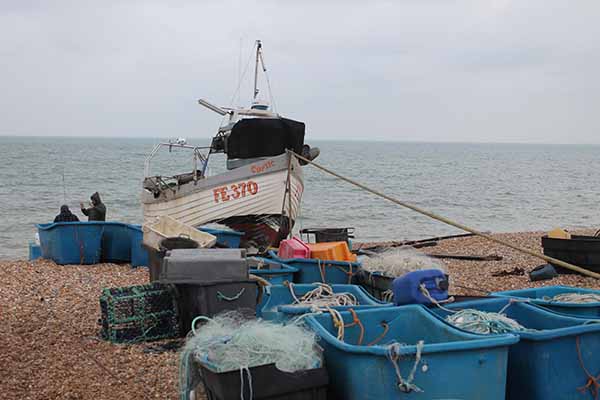 A plaque just south of Deal Castle declares this was the point Julius Caesar landed in Britain. Bearing in mind how much the coastline has changed in the almost 2,000 years since them it's probably a claim to be taken with a cellar of salt. A steep shingle beach meant the town was not popular with the Victorians so it escaped the Victorian resort development relatively unscathed so the town still retains its old charm. The town didn't even acquire a pier until 1957 and the 1,000 foot long pier is popular with anglers.
Like Brighton and Hove, Deal has an adjoining town, Walmer, and along the beach fishermen "park" their boats on the shingle and some sell their fish direct to the public.
On the green in Walmer is a bandstand, built as a memorial to 11 Royal Marines murdered by the Provisional IRA in a bomb attack on Deal Barracks in 1989.
The Time Ball Tower, as its name implies, is a tower with a black ball on top. Each day at 13:00 hours GMT the ball drops, enabling ships moored off the coast to synchronise their clocks, the tower is a museum of naval communication. Open Easter to September, Wednesday to Sunday, plus Bank Holidays. Admission Adult £3, Seniors and Children / concessions £2
Sandwich is another of the Kent ports now to be found inland, this time two miles from the sea as the crow flies. It can be accessed by water from Pegwell Bay but that entails a five mile winding journey up the River Stour. Boats can be launched from the towns slipway but only two hours either side of high tide. Medieval gates surround the town and the narrow roads are home to many, varied, independent shops.
Pegwell Bay is home to a nature reserve and it is also home to a replica of a Viking longboat. Nature reserve cost is £1.30 a day Monday to Friday, £2.00, weekends and Bank Holidays
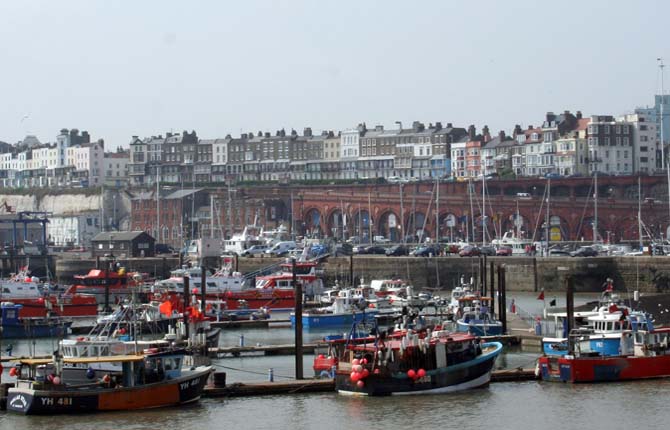 Ramsgate has one of the busiest harbours on the south coast and is very attractive at night. The harbour was given the title "Royal Harbour" following a visit by George IV in 1822.
More lively than neighbouring Broadstairs but quieter than nearby Margate it is a good middling resort. The sandy beach is safe for swimming, apart from next to the harbour wall. There is a well marked town trail to follow if you want help exploring the town.
Broadstairs is right next to Ramsgate but a complete contrast. A favourite haunt of Charles Dickens, it was here he wrote David Copperfield at the aptly named Bleak House. Unsurprisingly there is a Dickens Museum in the town, open Easter to November. Admission Adults £5.00, Concessions £3.50 and Children £2.50.
The town has a small, sheltered, sandy beach and a delightful little harbour.
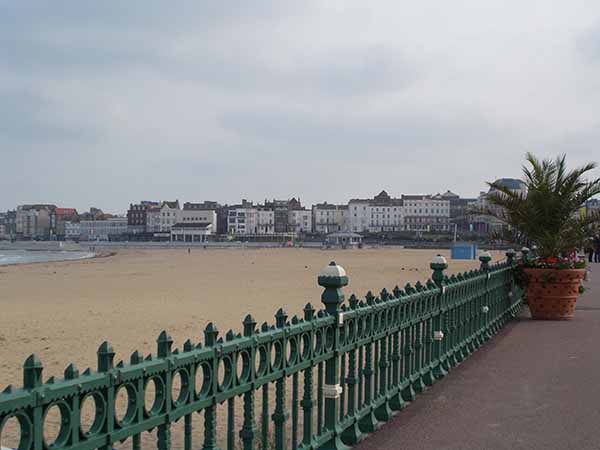 Even before the advent of the railway Londoners used to flock to Margate with its sweeping sandy beach, in those days arriving by sea in special boats called Margate Hoys. The gentle sloping beach is very safe and ideal for youngsters learning to swim. With amusements arcades a plenty and a larger than average funfair, the main attraction being a 140 feet high big wheel, the town is still a big draw for Londoners and locals alike. Margate once had a pier but that disappeared following a storm in 1978.
The Shell Grotto is a quirky attraction consisting of murals made from an estimated 4.6 million shells. Open Wednesday to Sunday. 2015 Admission: Adults £6.00, Concessions £5.00, Children £2.00
Margate is also home to the critically acclaimed Turner Contemporary Art Gallery, whilst for the young at heart the Hornby Visitor Centre will evoke memories of model railways and racing cars, open daily, Admission, Adults £5, Children and Seniors £2.50.
However Margate is one of those incredibly annoying seaside resorts and it typifies the decay and neglect prevalent in so many UK resorts. It had the potential to be a great resort but years of neglect simply add to a seedy feel around the town.
The Dreamland funfair is anything but a dream but has traditional seaside rides, £3.00 a ride or a very oddly priced £24.99 for an unlimited ride wristband. The skyline along the front is dominated by an ugly 1960's concrete tower block. Even the beautiful wrote iron shelters need a lick of paint and the broken glass displayed - it's almost as if the town has given up.
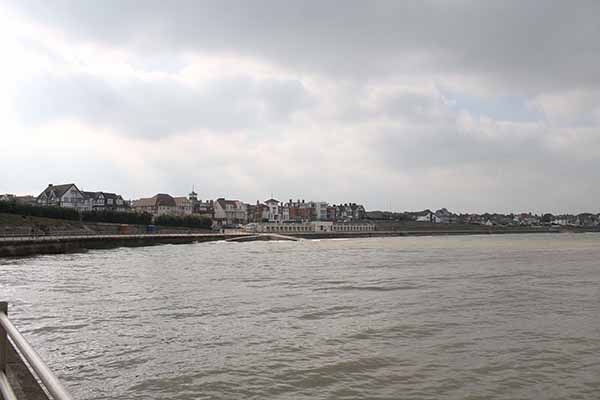 Westgate is on the outer edge of Margate, separated by cliffs which house a sunken garden between them. The sandy beach is popular and provides an antidote to its brasher neighbour, although the beach will be fully covered at high tide.
The sea wall is home to a very popular cafe and a row of pastel coloured beach huts add some colour.
Herne Bay is the complete contrast to Margate, developed in Victorian times it is a relaxed, well maintained, resort without the "kiss me quick" feel. The exposed beach is a sand / shingle mix and, like nearby Margate, the town lost its pier in the storm of 1978, leaving a short stump emerging from the beach with the "end" of the pier visible in the distance, cut off by an expanse of water.
The "stub" of the pier is home to a collection of "huts" housing an eclectic mix of outlets, ranging from a recording studio, through to a Thai eatery and not forgetting the obligatory clairvoyant.
An 80ft (24m) clock tower is the centrepiece of the seafront.
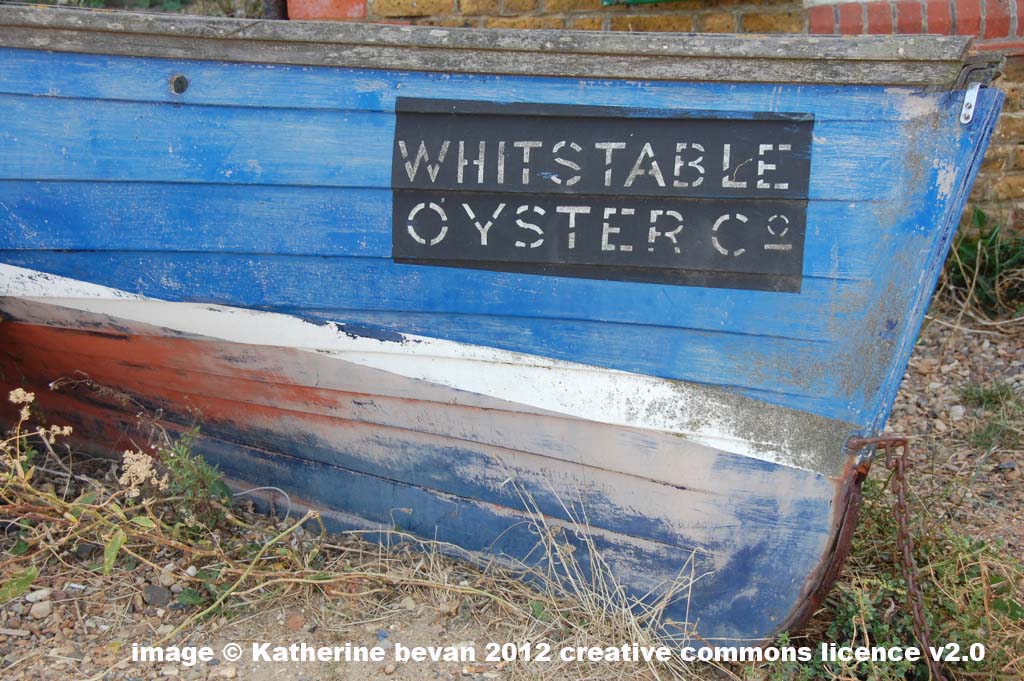 Whitstable is a fishing port famed for its oysters, now a delightful attraction with narrow streets and plenty of independent shops. Clearly there are plenty of seafood restaurants and in July each year there is a nine day Oyster festival. There are a couple of beaches and, unusually, neither has a promenade so are fairly quiet, there is a shingle spit which goes out to sea for about half a mile, which can be walked at low tide.
A word of warning though, parking is very limited and restricted in the town, so if it's a hot day arrive early.
Graveney Marshes is a large nature reserve attracting large numbers of waders and wildfowl in the winter and the grassland has abundant wild flowers.
Faversham is an unspoiled town with buildings surviving from throughout its long and illustrious history. The Chart Gunpowder Mills is a quirky museum telling the story of gunpowder, which was an important export from the town, admission is free with donations appreciated. Tours of the famous Shepherd Neame Brewery are available, advance booking is strongly recommended and children under twelve are not admitted.
Elmley Marsh is a 3,000 acre nature reserve open six days a week (closed Tuesdays) with free admission. Access is via a two mile track along which are stopping points to view the wildlife. From the car park it is a one mile walk to the bird hides.
Minster is a small village whose main claim to fame is being home to one of the oldest churches in the country.
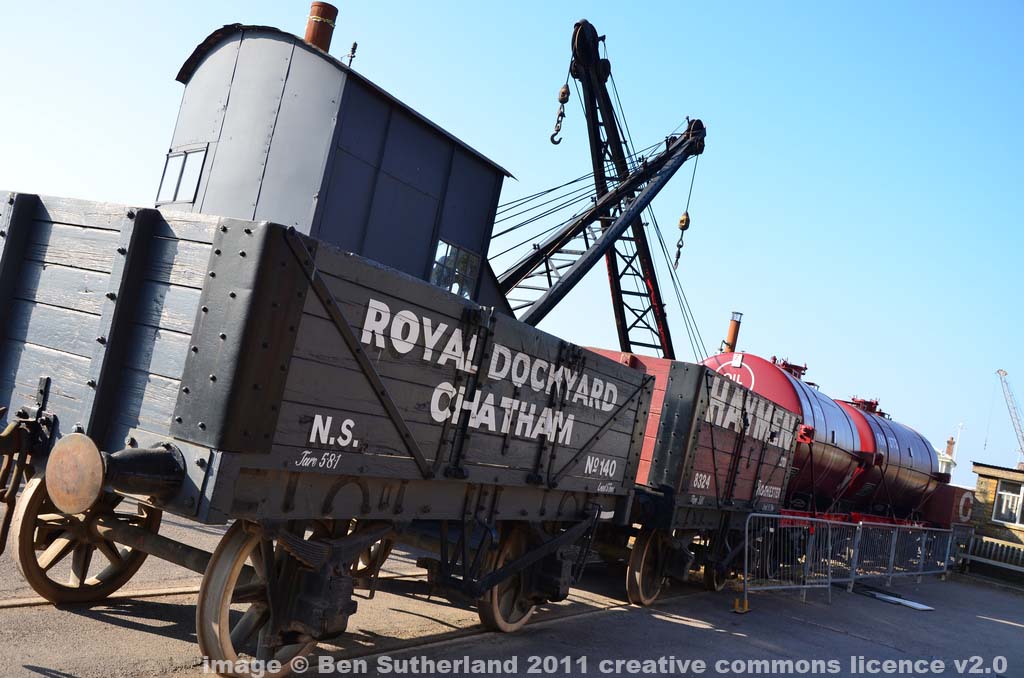 Chatham was one of three major Naval Dockyards in the south (Portsmouth and Plymouth being the others). The dockyard ceased shipbuilding in 1984 but the site has been transformed into The Historic Dockyard Museum. Charles Dickens father worked in the Dockyard in the Naval Pay Office and that is a sufficiently tenuous link for the town to have Dickens World, a recreation of a 19th century town.
There is a Charles Dickens centre at nearby Rochester but he did, at least, live there and used the town as the setting for Great Expectations and Pickwick Papers. The history of the city goes back much longer than Dickens though, with a settlement being here for around 2,000 years and it was a major Roman town. A museum in the Town Hall tells the history of the city. The cathedral dates back to 1077.
Gravesend has a prime position at the mouth of the River Thames and it is still home to the Port Of London Authority Thames Navigation Service. Gordon Promenade offers stunning views across the Thames. The towns most famous character ended up being immortalised by Disney as the Red Indian Princess Pocahontas came to the town in 1616 and a statue of her can be found in St George's churchyard, where she is buried.
Sadly there is little else to say about the town except to say it is appropriately named, it is a depressing, neglected, soulless place and not worth going out of your way to visit.
Crossing the River Thames to the Essex side of the river and Tilbury is just about all that remains of the once busy Port Of London, although little can be seen as the port is surrounded by a high brick wall.
Canvey Island is fairly nondescript, although the sea wall does offer views across the Thames to the Kent side of the river.
Leigh-On-Sea is not a major resort with the seafront cut off from the town by the railway. There are stalls selling jellied eels and local cockles.
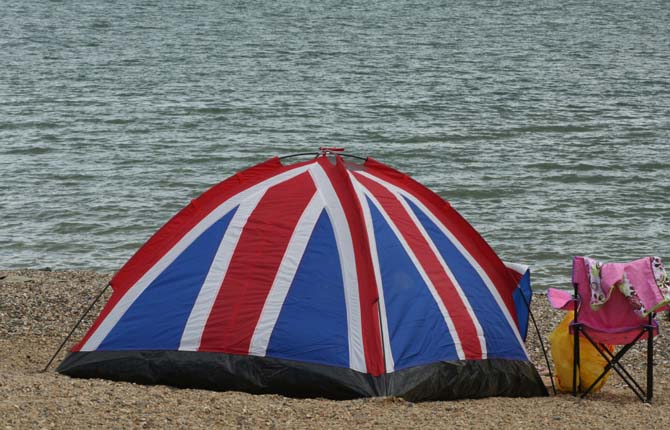 Southend is often called "London's resort" but it is a major town in its own right. An archetypical British seaside resort it is home to amusement arcades, fish and chip and seafood stalls as well as a large funfair. Southend is also home to the longest pier in the world stretching 1.3 miles (2.1km) into the Thames Estuary and if you don't fancy the walk an electric train will take you to the end of it. As well as the beaches there are also 1,100 acres of public gardens in the town.
Large parts of the beach at Shoeburyness are closed to the public as they are used as military firing ranges, however the East beach offers good views of the Thames Estuary.
Burnham-on-Crouch was once a major oyster centre but is now home to a large marina. The two highlights in the town are the boat show in June and a large sailing week in August. The town itself is very quaint and the harbour area is pedestrianised.
St Peter's Chapel is near the village of Bradwell On Sea and is one of the oldest churches in the country. You can drive to within half a mile of the church, the final leg has to be completed on foot. Past the chapel is a sea wall with walks in both directions.
Maldon is reportedly one of the oldest inhabited settlements in Essex and is home to many Thames barges. The Quay is next to a grass edged promenade. Barge racing is held during the summer months and boat trips are available March to October.
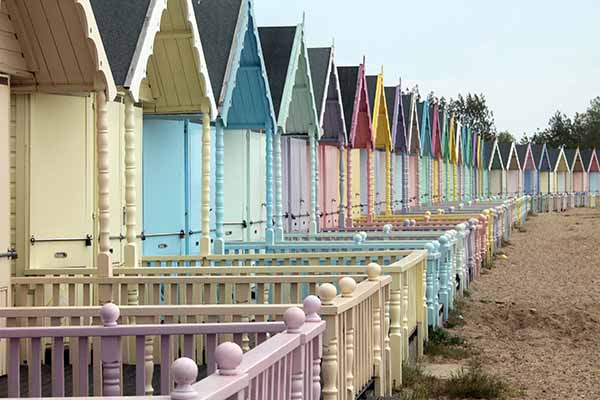 Mersea Island is approached by a causeway and is a little world apart. East Mersea is the rural end of the island with mudflats, a nature reserve and a sand and shingle beach, although strong currents mean swimming is not recommended. West Mersea is the main resort and boating area, although having said that it's still a very genteel resort. Locally grown oysters can be purchased and there is an interesting local history museum. One of the highlights is the line of beach huts at West Mersea, many of them in pastel colours - 250 of them in all. The Mersea Regatta has taken place every August since 1838.
Colchester is the oldest recorded town and first major Roman settlement in the country.
There has been shipbuilding at Withenhoe since Elizabethan times. A narrow street of old houses leads to the quay, a scene that is probably unchanged for a couple of centuries. At nearby Elmstead Market the renown Beth Chatto Gardens can be found. The gardens are open all year except January. Admission is limited, so booking in advance is highly recommended, Adult £14.95, child £3.50, NHS and Blue LIght card holders £11.95 and students £7.95
Brightlingsea is effectively on its own island with only one road providing access. It's wide sweeping beach is ideal for launching boats of all shapes and sizes and it has been an important shipping centre throughout its history. The town is home to the Smack Preservation Society and there is a race from Brightlingsea to Clacton and back every September.
Clacton was a small village until the 1860's when it was swept up in the Victorian fascination with the seaside and it rapidly developed to be second only to Southend in the list of Essex resorts. Home to a sweeping sandy beach, flanked by a traffic free promenade and lush gardens, the town has a wide pier housing an amusement arcade and funfair, with some good fishing available from the end. The town has two theatres and if the main resort is a bit too busy for you then Holland-on-Sea to the north is much quieter and beyond there is Holland Haven Country Park.
Until 2000 Frinton had the enviable position of being the only UK resort without a pub - sadly that is no longer the case. Frinton is still very much a genteel town with a lovely sandy beach.
Walton-on-the-Naze runs on from Frinton and is a more traditional resort and home to the second longest pier in the country (after Southend). The slight downside is the beach is almost entirely covered at high tide. Just north of the resort is The Naze, a wide area of grass and gorse and home to a tower which used to be a navigation aid but is now a maritime museum. The headland offers fine views of ships sailing in and out of the major ports of Harwich and Felixstow.
Raleigh, Drake and Nelson are just three seafarers who have sailed from Harwich and monarchs as diverse as Edward III and Elizabeth I have seen their fleets sail from the port. Shipping still plays a major role in the town with it being the departure point for the passenger ferry to The Netherlands and freight ferries across Europe. A Maritime Heritage Trail wends its way through the old town. The old Quay offers viewing of the busy port as well as Felixstow, across the water.
Mistley is a small commercial port with an active malthouse which provides a background aroma. A key attraction is the 400 mute swans who reside in the town.
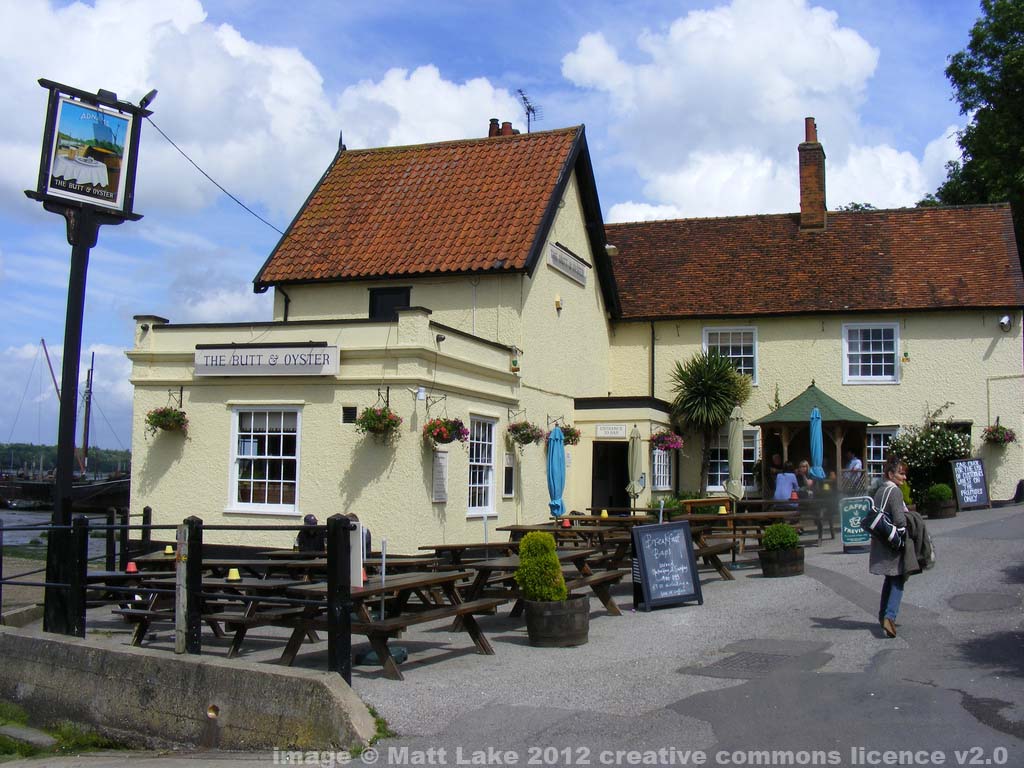 Pin Mill is a delightful little village named after the wooden pegs or pins used in shipbuilding, carried out in the village. The local pub, the Butt And Oyster sailors can moor alongside the pub and order their drinks from their boats. The Pin Mill Barge Mach sees brightly coloured barges sailing by in late June or early July.
Suffolk's county town, Ipswich, was one of the countries most prosperous ports in the middle ages and despite being 12 miles from the sea it is still a busy port. A Maritime Trail explores the old port area of the town. Cardinal Wolsey was born in Ipswich and many Tudor buildings still survive. There are two museums in the town.
Felixstow is a town of contrasts. On the one hand it has a sweeping bay with a sand and shingle shore backed by a promenade and well tended seafront gardens. North of the Spa the beach is lined with traditional bathing huts. On the other hand the town is home to one of the largest container ports in the world.
Woodbridge is considered by some to be one of the most picturesque towns in East Anglia, with timber framed Georgian houses and steep streets running down to the quayside. The Suffolk Horse Museum tells the story of the giant working horse. Nearby Sutton Hoo is home to Saxon burial mounds. Personally I would say it's OK but there are more attractive towns.
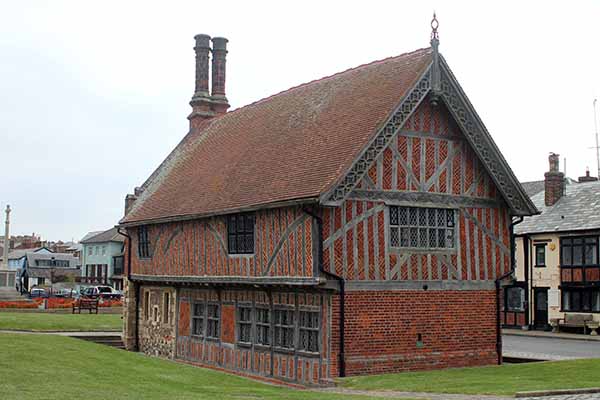 Aldeburgh was mentioned in the Doomsday Book and was a busy port by the 1600's. A line of elegant Georgian houses and older cottages face the shingle beach. The beach is home to a plentiful number of fishermen's shacks, some doubling as smoke houses and most selling their wares direct to the public. Nowadays the town is famous due to its music festival, founded by former local resident Benjamin Britten.
Thorpeness is a purpose built holiday centre near Aldeburgh built around an artificial lake. The prettiest attraction is a restored post mill.
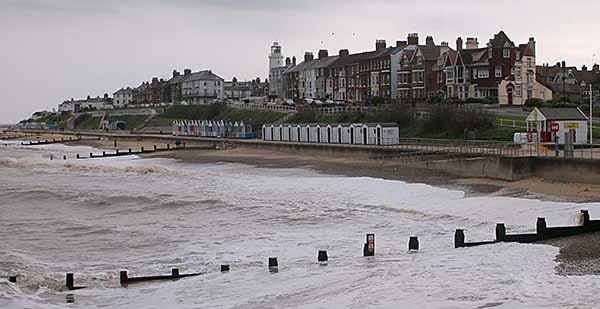 Southwold is an unspoiled town with a combination of redbrick and colour washed houses built around a series of greens. The sandy beach is home to many brightly coloured beach huts. The tallest buildings in the town are the flint built parish church and white Victorian lighthouse. There is a Lifeboat Museum in the town and Gun Hill is home to six 18lb cannons. The pier is well worth a visit - there is no funfair but it has the usual shops and eateries, however these are slightly more upmarket than the usual tacky shops found on many piers, it is also home to an intriguing water powered clock. Behind the pier is a mural paying tribute to a former resident, the author George Orwell - the fact it's tucked away on the back of the pier underlines how understated the resort is. A delightful resort and well worth a visit - unfortunately I suspect the delight isn't a secret as the guest houses appear well before you reach the town.
Set either side of an inlet called Lake Lothong, Lowestoft is still a fishing port as well as being an important port in the supply of offshore oil fields. Before overfishing depleted stocks, herring was the main catch landed at the port, although nowadays the catch is more varied. The port is on the northern side of the inlet, whilst the southern side of the town is home to the resort which has a sandy beach and not one but two piers.
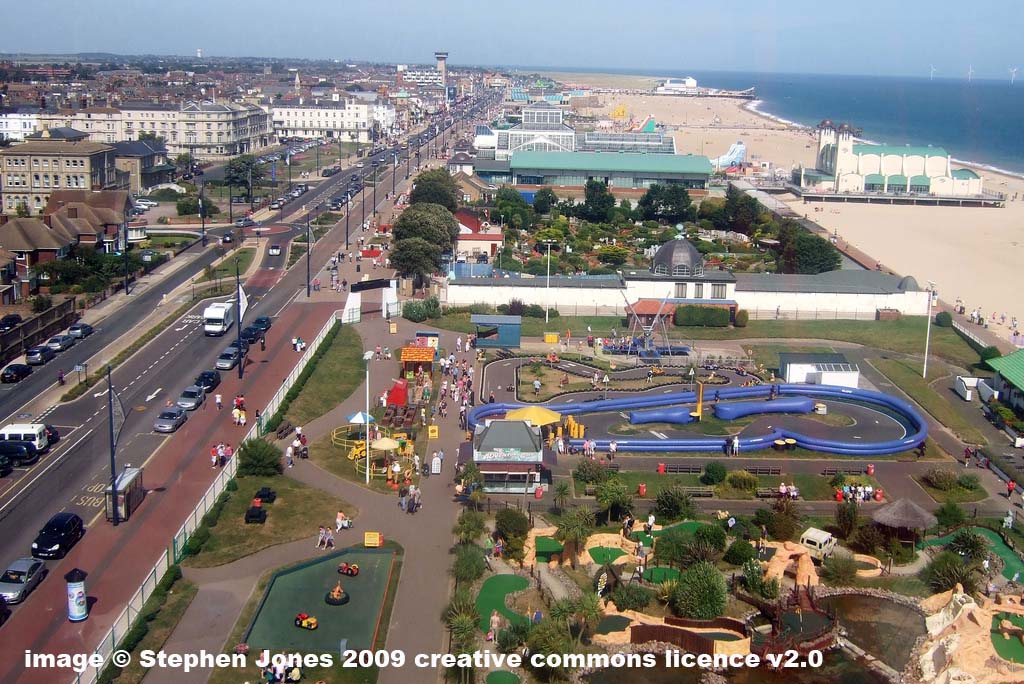 Like Lowestoft, Great Yarmouth began life as a herring port and whilst a port still survives the town is now known primarily as a brash resort with four miles of sandy beaches, two piers and a fairground as well as a number of holiday camps. There is plenty of culture in the town, with the 13th century Tollhouse, one of the oldest surviving civic buildings in England and now a centre for brass-rubbing. The Elizabethan House, dating from 1596, is a museum of domestic life. A former Victorian herring-curing centre is now a maritime museum and the Sea Life Centre is a massive aquarium. If you like a flutter there is a racecourse and a greyhound stadium within walking distance of the seafront. The town has its own Nelsons Column at 144 feet(44m) tall and on certain days in the summer the fit may climb the 270 steps to the top and a stunning view.
Caister can trace its roots back to 125AD when it was an important Roman port and the excavated remains are on view around the old port. Nearby Caister Castle was built in the 1430's and there is a motor museum with some 200 exhibits. If you want the quiet life there is a wide sandy beach, although it does shelve in places and there can be strong currents to trap the unwary.
Hemsby is an isolates spot with an attractive sandy beach, although parking is limited - very much a quiet, no frills location.
If you wanted a perfect example of an isolated beach then look no further than Horsey. Accessible by rough roads the village has a church with a thatched roof. A circular walk from the church takes in Horsey Waterpump, used to drain excess water from agricultural land. Nearby Horsey Mere is a breeding ground for many species of wildfowl.
The dunes at Waxham are also isolated but those who park at the disused church and brave the sandy track will be rewarded with a delightful sandy beach. Next to the church is the longest thatched barn in Norfolk.
Nearby Sea Palling is a hidden gem, approached by an uninspiring lane you still don't expect much when you park up in the nondescript, almost derelict, car park. However venture down the slipway and you will find a delightful sheltered beach, popular with water sports fans. A breakwater provides safe bathing for families. Apart from a couple of particularly uninspiring shops there is little else in the resort, although there are some holiday sites nearby, which probably account for most of the visitors.
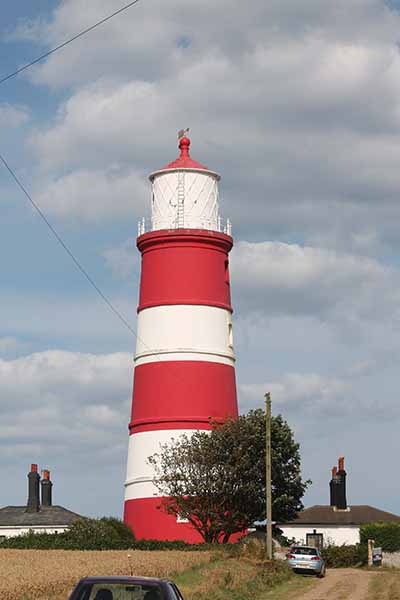 Happisburg, pronounced "Hazeborough" has plenty of thatched buildings but the highlight is the 176 foot (54m) red and white striped lighthouse. The town has a small, sandy beach.
You could very easily drive through Mundesley (another town with an odd pronunciation, this time "Munsley") and not notice it, however if you did so then you would be making a big mistake as away from the unassuming seafront road is a lovely resort with a sweeping sandy beach faced by a row of brightly painted beach huts, the town is also home to an interesting maritime museum.
Cromer is renown for its crabs and there are plenty of places to buy them during the season. Some of the old flint cottages have been preserved to create a museum showing life over the past 100 odd years. With sandy beaches and a long pier, housing a theatre providing traditional seaside entertainment.
West Runton has two claims to fame, firstly it is home to the Norfolk Shire Horse Centre and just to the south is Beacon Hill, at 329ft (100m) above sea level, the highest point in an otherwise flat Norfolk.
Sheringham is a small but busy resort which came into its own with the arrival of the railway in 1887. A small fishing fleet land crabs and lobsters and when not at sea the boats are drawn up onto the beach. During the summer a steam railway operates from the town.
As a result of silting only the smallest of boats can now reach Blakeney, which once had a fishing fleet who travelled as far as Iceland.
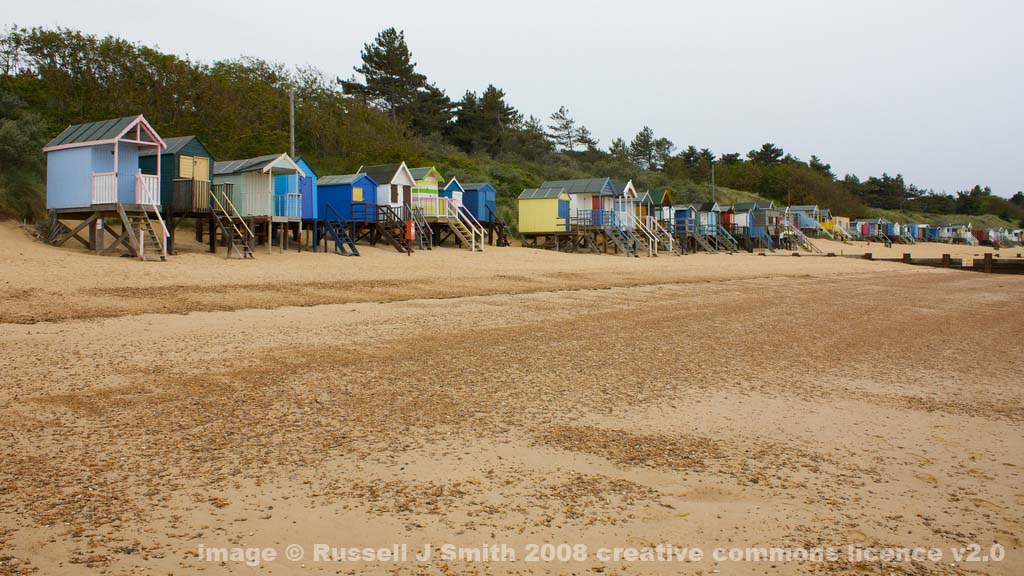 Wells-next-the-Sea has a beach a mile north of the town but it is next to the fishing port in the town itself that the amusement arcades can be found. The beach stretches out for almost a mile at low tide. Reclaimed land adjoining the sea wall is home to a large boating lake and nearby is the Holkham Nature Reserve.
From the outside Holkham Hall looks a large but plain, austere building but don't be fooled. Inside it houses many Old Masters and fine tapestries. The Bygones Museum, housed in the old stable block, is a veritable treasure trove with antique tools, tractors, cars, steam engines, domestic items and much more. The house is open Monday, Thursday and Sunday £24.00 adult and £2.50 children, this includes garden entry. The garden is open daily April - November Adults £7.00, children £1.00
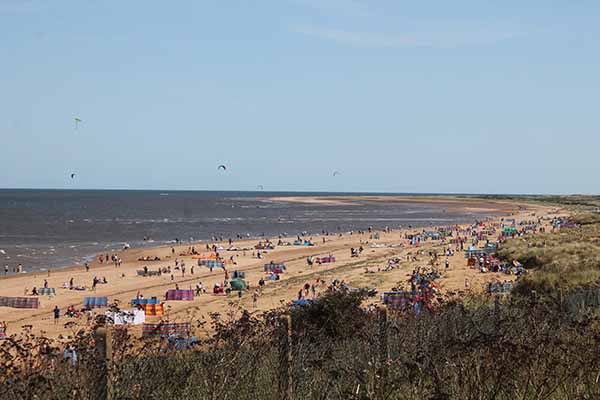 Hunstanton is unique in East Anglia in it is the only resort which faces west and is the only resort with cliffs, albeit only 60ft (18m) high. Behind the esplanade is a broad grassy swathe and what remains of the pier is home to an amusement arcade.
Sandringham is where The Royal Family traditionally spends Christmas and it was bought by Queen Victoria for the then Prince of Wales. He rebuilt the house in 1870. The house is open to the public from March to October (closed late July and late August) Admission: Adults House, Museum and Gardens £26, Gardens only £17 Children free. Parking is £5. Advance booking recommended and discounts for advanced / online bookings. The Country Park is open every day and is free.
Granted a Royal Charter by King John in 1204 Kings Lynn has architecture surviving from throughout its history, the jewel of which is the St George's Guildhall, dating back to the 15th century, the oldest surviving, intact Guildhall in the country.
The tower of St Botolph's Church in Boston has a lantern above it as it serves as a navigation aid for shipping using the port. Those who brave the 360 step climb to the top of the tower, known locally as The Stump will be rewarded with spectacular views. Nearby is the Maud Foster Windmill, said to be Britain's highest and a rarity in it has five sails. It is open to the public weekends and Wednesdays.
Previous: Portsmouth - Dover Next: Skegness - Berwick
A plaque just south of Deal Castle declares this was the point Julius Caesar landed in Britain. Bearing in mind how much the coastline has changed in the almost 2,000 years since them it's probably a claim to be taken with a cellar of salt. A steep shingle beach meant the town was not popular with the Victorians so it escaped the Victorian resort development relatively unscathed so the town still retains its old charm. The town didn't even acquire a pier until 1957 and the 1,000 foot long pier is popular with anglers.Like Brighton and Hove, Deal has an adjoining town, Walmer, and along the beach fishermen "park" their boats on the shingle and some sell their fish direct to the public.
On the green in Walmer is a bandstand, built as a memorial to 11 Royal Marines murdered by the Provisional IRA in a bomb attack on Deal Barracks in 1989.
The Time Ball Tower, as its name implies, is a tower with a black ball on top. Each day at 13:00 hours GMT the ball drops, enabling ships moored off the coast to synchronise their clocks, the tower is a museum of naval communication. Open Easter to September, Wednesday to Sunday, plus Bank Holidays. Admission Adult £3, Seniors and Children / concessions £2
Sandwich is another of the Kent ports now to be found inland, this time two miles from the sea as the crow flies. It can be accessed by water from Pegwell Bay but that entails a five mile winding journey up the River Stour. Boats can be launched from the towns slipway but only two hours either side of high tide. Medieval gates surround the town and the narrow roads are home to many, varied, independent shops.
Pegwell Bay is home to a nature reserve and it is also home to a replica of a Viking longboat. Nature reserve cost is £1.30 a day Monday to Friday, £2.00, weekends and Bank Holidays
Ramsgate has one of the busiest harbours on the south coast and is very attractive at night. The harbour was given the title "Royal Harbour" following a visit by George IV in 1822.More lively than neighbouring Broadstairs but quieter than nearby Margate it is a good middling resort. The sandy beach is safe for swimming, apart from next to the harbour wall. There is a well marked town trail to follow if you want help exploring the town.
Broadstairs is right next to Ramsgate but a complete contrast. A favourite haunt of Charles Dickens, it was here he wrote David Copperfield at the aptly named Bleak House. Unsurprisingly there is a Dickens Museum in the town, open Easter to November. Admission Adults £5.00, Concessions £3.50 and Children £2.50.
The town has a small, sheltered, sandy beach and a delightful little harbour.
Even before the advent of the railway Londoners used to flock to Margate with its sweeping sandy beach, in those days arriving by sea in special boats called Margate Hoys. The gentle sloping beach is very safe and ideal for youngsters learning to swim. With amusements arcades a plenty and a larger than average funfair, the main attraction being a 140 feet high big wheel, the town is still a big draw for Londoners and locals alike. Margate once had a pier but that disappeared following a storm in 1978.The Shell Grotto is a quirky attraction consisting of murals made from an estimated 4.6 million shells. Open Wednesday to Sunday. 2015 Admission: Adults £6.00, Concessions £5.00, Children £2.00
Margate is also home to the critically acclaimed Turner Contemporary Art Gallery, whilst for the young at heart the Hornby Visitor Centre will evoke memories of model railways and racing cars, open daily, Admission, Adults £5, Children and Seniors £2.50.
However Margate is one of those incredibly annoying seaside resorts and it typifies the decay and neglect prevalent in so many UK resorts. It had the potential to be a great resort but years of neglect simply add to a seedy feel around the town.
The Dreamland funfair is anything but a dream but has traditional seaside rides, £3.00 a ride or a very oddly priced £24.99 for an unlimited ride wristband. The skyline along the front is dominated by an ugly 1960's concrete tower block. Even the beautiful wrote iron shelters need a lick of paint and the broken glass displayed - it's almost as if the town has given up.
Westgate is on the outer edge of Margate, separated by cliffs which house a sunken garden between them. The sandy beach is popular and provides an antidote to its brasher neighbour, although the beach will be fully covered at high tide. The sea wall is home to a very popular cafe and a row of pastel coloured beach huts add some colour.
Herne Bay is the complete contrast to Margate, developed in Victorian times it is a relaxed, well maintained, resort without the "kiss me quick" feel. The exposed beach is a sand / shingle mix and, like nearby Margate, the town lost its pier in the storm of 1978, leaving a short stump emerging from the beach with the "end" of the pier visible in the distance, cut off by an expanse of water.
The "stub" of the pier is home to a collection of "huts" housing an eclectic mix of outlets, ranging from a recording studio, through to a Thai eatery and not forgetting the obligatory clairvoyant.
An 80ft (24m) clock tower is the centrepiece of the seafront.
Whitstable is a fishing port famed for its oysters, now a delightful attraction with narrow streets and plenty of independent shops. Clearly there are plenty of seafood restaurants and in July each year there is a nine day Oyster festival. There are a couple of beaches and, unusually, neither has a promenade so are fairly quiet, there is a shingle spit which goes out to sea for about half a mile, which can be walked at low tide.A word of warning though, parking is very limited and restricted in the town, so if it's a hot day arrive early.
Graveney Marshes is a large nature reserve attracting large numbers of waders and wildfowl in the winter and the grassland has abundant wild flowers.
Faversham is an unspoiled town with buildings surviving from throughout its long and illustrious history. The Chart Gunpowder Mills is a quirky museum telling the story of gunpowder, which was an important export from the town, admission is free with donations appreciated. Tours of the famous Shepherd Neame Brewery are available, advance booking is strongly recommended and children under twelve are not admitted.
Elmley Marsh is a 3,000 acre nature reserve open six days a week (closed Tuesdays) with free admission. Access is via a two mile track along which are stopping points to view the wildlife. From the car park it is a one mile walk to the bird hides.
Minster is a small village whose main claim to fame is being home to one of the oldest churches in the country.
Chatham was one of three major Naval Dockyards in the south (Portsmouth and Plymouth being the others). The dockyard ceased shipbuilding in 1984 but the site has been transformed into The Historic Dockyard Museum. Charles Dickens father worked in the Dockyard in the Naval Pay Office and that is a sufficiently tenuous link for the town to have Dickens World, a recreation of a 19th century town.There is a Charles Dickens centre at nearby Rochester but he did, at least, live there and used the town as the setting for Great Expectations and Pickwick Papers. The history of the city goes back much longer than Dickens though, with a settlement being here for around 2,000 years and it was a major Roman town. A museum in the Town Hall tells the history of the city. The cathedral dates back to 1077.
Gravesend has a prime position at the mouth of the River Thames and it is still home to the Port Of London Authority Thames Navigation Service. Gordon Promenade offers stunning views across the Thames. The towns most famous character ended up being immortalised by Disney as the Red Indian Princess Pocahontas came to the town in 1616 and a statue of her can be found in St George's churchyard, where she is buried.
Sadly there is little else to say about the town except to say it is appropriately named, it is a depressing, neglected, soulless place and not worth going out of your way to visit.
Crossing the River Thames to the Essex side of the river and Tilbury is just about all that remains of the once busy Port Of London, although little can be seen as the port is surrounded by a high brick wall.
Canvey Island is fairly nondescript, although the sea wall does offer views across the Thames to the Kent side of the river.
Leigh-On-Sea is not a major resort with the seafront cut off from the town by the railway. There are stalls selling jellied eels and local cockles.
Southend is often called "London's resort" but it is a major town in its own right. An archetypical British seaside resort it is home to amusement arcades, fish and chip and seafood stalls as well as a large funfair. Southend is also home to the longest pier in the world stretching 1.3 miles (2.1km) into the Thames Estuary and if you don't fancy the walk an electric train will take you to the end of it. As well as the beaches there are also 1,100 acres of public gardens in the town.Large parts of the beach at Shoeburyness are closed to the public as they are used as military firing ranges, however the East beach offers good views of the Thames Estuary.
Burnham-on-Crouch was once a major oyster centre but is now home to a large marina. The two highlights in the town are the boat show in June and a large sailing week in August. The town itself is very quaint and the harbour area is pedestrianised.
St Peter's Chapel is near the village of Bradwell On Sea and is one of the oldest churches in the country. You can drive to within half a mile of the church, the final leg has to be completed on foot. Past the chapel is a sea wall with walks in both directions.
Maldon is reportedly one of the oldest inhabited settlements in Essex and is home to many Thames barges. The Quay is next to a grass edged promenade. Barge racing is held during the summer months and boat trips are available March to October.
Mersea Island is approached by a causeway and is a little world apart. East Mersea is the rural end of the island with mudflats, a nature reserve and a sand and shingle beach, although strong currents mean swimming is not recommended. West Mersea is the main resort and boating area, although having said that it's still a very genteel resort. Locally grown oysters can be purchased and there is an interesting local history museum. One of the highlights is the line of beach huts at West Mersea, many of them in pastel colours - 250 of them in all. The Mersea Regatta has taken place every August since 1838.Colchester is the oldest recorded town and first major Roman settlement in the country.
There has been shipbuilding at Withenhoe since Elizabethan times. A narrow street of old houses leads to the quay, a scene that is probably unchanged for a couple of centuries. At nearby Elmstead Market the renown Beth Chatto Gardens can be found. The gardens are open all year except January. Admission is limited, so booking in advance is highly recommended, Adult £14.95, child £3.50, NHS and Blue LIght card holders £11.95 and students £7.95
Brightlingsea is effectively on its own island with only one road providing access. It's wide sweeping beach is ideal for launching boats of all shapes and sizes and it has been an important shipping centre throughout its history. The town is home to the Smack Preservation Society and there is a race from Brightlingsea to Clacton and back every September.
Clacton was a small village until the 1860's when it was swept up in the Victorian fascination with the seaside and it rapidly developed to be second only to Southend in the list of Essex resorts. Home to a sweeping sandy beach, flanked by a traffic free promenade and lush gardens, the town has a wide pier housing an amusement arcade and funfair, with some good fishing available from the end. The town has two theatres and if the main resort is a bit too busy for you then Holland-on-Sea to the north is much quieter and beyond there is Holland Haven Country Park.
Until 2000 Frinton had the enviable position of being the only UK resort without a pub - sadly that is no longer the case. Frinton is still very much a genteel town with a lovely sandy beach.
Walton-on-the-Naze runs on from Frinton and is a more traditional resort and home to the second longest pier in the country (after Southend). The slight downside is the beach is almost entirely covered at high tide. Just north of the resort is The Naze, a wide area of grass and gorse and home to a tower which used to be a navigation aid but is now a maritime museum. The headland offers fine views of ships sailing in and out of the major ports of Harwich and Felixstow.
Raleigh, Drake and Nelson are just three seafarers who have sailed from Harwich and monarchs as diverse as Edward III and Elizabeth I have seen their fleets sail from the port. Shipping still plays a major role in the town with it being the departure point for the passenger ferry to The Netherlands and freight ferries across Europe. A Maritime Heritage Trail wends its way through the old town. The old Quay offers viewing of the busy port as well as Felixstow, across the water.
Mistley is a small commercial port with an active malthouse which provides a background aroma. A key attraction is the 400 mute swans who reside in the town.
Pin Mill is a delightful little village named after the wooden pegs or pins used in shipbuilding, carried out in the village. The local pub, the Butt And Oyster sailors can moor alongside the pub and order their drinks from their boats. The Pin Mill Barge Mach sees brightly coloured barges sailing by in late June or early July.Suffolk's county town, Ipswich, was one of the countries most prosperous ports in the middle ages and despite being 12 miles from the sea it is still a busy port. A Maritime Trail explores the old port area of the town. Cardinal Wolsey was born in Ipswich and many Tudor buildings still survive. There are two museums in the town.
Felixstow is a town of contrasts. On the one hand it has a sweeping bay with a sand and shingle shore backed by a promenade and well tended seafront gardens. North of the Spa the beach is lined with traditional bathing huts. On the other hand the town is home to one of the largest container ports in the world.
Woodbridge is considered by some to be one of the most picturesque towns in East Anglia, with timber framed Georgian houses and steep streets running down to the quayside. The Suffolk Horse Museum tells the story of the giant working horse. Nearby Sutton Hoo is home to Saxon burial mounds. Personally I would say it's OK but there are more attractive towns.
Aldeburgh was mentioned in the Doomsday Book and was a busy port by the 1600's. A line of elegant Georgian houses and older cottages face the shingle beach. The beach is home to a plentiful number of fishermen's shacks, some doubling as smoke houses and most selling their wares direct to the public. Nowadays the town is famous due to its music festival, founded by former local resident Benjamin Britten.Thorpeness is a purpose built holiday centre near Aldeburgh built around an artificial lake. The prettiest attraction is a restored post mill.
Southwold is an unspoiled town with a combination of redbrick and colour washed houses built around a series of greens. The sandy beach is home to many brightly coloured beach huts. The tallest buildings in the town are the flint built parish church and white Victorian lighthouse. There is a Lifeboat Museum in the town and Gun Hill is home to six 18lb cannons. The pier is well worth a visit - there is no funfair but it has the usual shops and eateries, however these are slightly more upmarket than the usual tacky shops found on many piers, it is also home to an intriguing water powered clock. Behind the pier is a mural paying tribute to a former resident, the author George Orwell - the fact it's tucked away on the back of the pier underlines how understated the resort is. A delightful resort and well worth a visit - unfortunately I suspect the delight isn't a secret as the guest houses appear well before you reach the town.Set either side of an inlet called Lake Lothong, Lowestoft is still a fishing port as well as being an important port in the supply of offshore oil fields. Before overfishing depleted stocks, herring was the main catch landed at the port, although nowadays the catch is more varied. The port is on the northern side of the inlet, whilst the southern side of the town is home to the resort which has a sandy beach and not one but two piers.
Like Lowestoft, Great Yarmouth began life as a herring port and whilst a port still survives the town is now known primarily as a brash resort with four miles of sandy beaches, two piers and a fairground as well as a number of holiday camps. There is plenty of culture in the town, with the 13th century Tollhouse, one of the oldest surviving civic buildings in England and now a centre for brass-rubbing. The Elizabethan House, dating from 1596, is a museum of domestic life. A former Victorian herring-curing centre is now a maritime museum and the Sea Life Centre is a massive aquarium. If you like a flutter there is a racecourse and a greyhound stadium within walking distance of the seafront. The town has its own Nelsons Column at 144 feet(44m) tall and on certain days in the summer the fit may climb the 270 steps to the top and a stunning view.Caister can trace its roots back to 125AD when it was an important Roman port and the excavated remains are on view around the old port. Nearby Caister Castle was built in the 1430's and there is a motor museum with some 200 exhibits. If you want the quiet life there is a wide sandy beach, although it does shelve in places and there can be strong currents to trap the unwary.
Hemsby is an isolates spot with an attractive sandy beach, although parking is limited - very much a quiet, no frills location.
If you wanted a perfect example of an isolated beach then look no further than Horsey. Accessible by rough roads the village has a church with a thatched roof. A circular walk from the church takes in Horsey Waterpump, used to drain excess water from agricultural land. Nearby Horsey Mere is a breeding ground for many species of wildfowl.
The dunes at Waxham are also isolated but those who park at the disused church and brave the sandy track will be rewarded with a delightful sandy beach. Next to the church is the longest thatched barn in Norfolk.
Nearby Sea Palling is a hidden gem, approached by an uninspiring lane you still don't expect much when you park up in the nondescript, almost derelict, car park. However venture down the slipway and you will find a delightful sheltered beach, popular with water sports fans. A breakwater provides safe bathing for families. Apart from a couple of particularly uninspiring shops there is little else in the resort, although there are some holiday sites nearby, which probably account for most of the visitors.
Happisburg, pronounced "Hazeborough" has plenty of thatched buildings but the highlight is the 176 foot (54m) red and white striped lighthouse. The town has a small, sandy beach.You could very easily drive through Mundesley (another town with an odd pronunciation, this time "Munsley") and not notice it, however if you did so then you would be making a big mistake as away from the unassuming seafront road is a lovely resort with a sweeping sandy beach faced by a row of brightly painted beach huts, the town is also home to an interesting maritime museum.
Cromer is renown for its crabs and there are plenty of places to buy them during the season. Some of the old flint cottages have been preserved to create a museum showing life over the past 100 odd years. With sandy beaches and a long pier, housing a theatre providing traditional seaside entertainment.
West Runton has two claims to fame, firstly it is home to the Norfolk Shire Horse Centre and just to the south is Beacon Hill, at 329ft (100m) above sea level, the highest point in an otherwise flat Norfolk.
Sheringham is a small but busy resort which came into its own with the arrival of the railway in 1887. A small fishing fleet land crabs and lobsters and when not at sea the boats are drawn up onto the beach. During the summer a steam railway operates from the town.
As a result of silting only the smallest of boats can now reach Blakeney, which once had a fishing fleet who travelled as far as Iceland.
Wells-next-the-Sea has a beach a mile north of the town but it is next to the fishing port in the town itself that the amusement arcades can be found. The beach stretches out for almost a mile at low tide. Reclaimed land adjoining the sea wall is home to a large boating lake and nearby is the Holkham Nature Reserve.From the outside Holkham Hall looks a large but plain, austere building but don't be fooled. Inside it houses many Old Masters and fine tapestries. The Bygones Museum, housed in the old stable block, is a veritable treasure trove with antique tools, tractors, cars, steam engines, domestic items and much more. The house is open Monday, Thursday and Sunday £24.00 adult and £2.50 children, this includes garden entry. The garden is open daily April - November Adults £7.00, children £1.00
Hunstanton is unique in East Anglia in it is the only resort which faces west and is the only resort with cliffs, albeit only 60ft (18m) high. Behind the esplanade is a broad grassy swathe and what remains of the pier is home to an amusement arcade.Sandringham is where The Royal Family traditionally spends Christmas and it was bought by Queen Victoria for the then Prince of Wales. He rebuilt the house in 1870. The house is open to the public from March to October (closed late July and late August) Admission: Adults House, Museum and Gardens £26, Gardens only £17 Children free. Parking is £5. Advance booking recommended and discounts for advanced / online bookings. The Country Park is open every day and is free.
Granted a Royal Charter by King John in 1204 Kings Lynn has architecture surviving from throughout its history, the jewel of which is the St George's Guildhall, dating back to the 15th century, the oldest surviving, intact Guildhall in the country.
The tower of St Botolph's Church in Boston has a lantern above it as it serves as a navigation aid for shipping using the port. Those who brave the 360 step climb to the top of the tower, known locally as The Stump will be rewarded with spectacular views. Nearby is the Maud Foster Windmill, said to be Britain's highest and a rarity in it has five sails. It is open to the public weekends and Wednesdays.
Previous: Portsmouth - Dover Next: Skegness - Berwick