
Coast - Bristol to Portchester
This section of the coastal tour takes in the rugged coastline of south west England and the Jurassic coastline.
Beginning in the port of Bristol we venture around the rugged coastline of the south west peninsular taking in the iconic resorts.
We then travel along the Jurassic coast with shingle spits, coastal towns, the port of Southampton and finishing up at Roman Portchester Castle.
This section of the site is constantly being updated, so keep coming back for the latest updates.
Clicking location names highlighted in bold purple will open a new page with more detailed information
Prices quoted are correct as of May 2026
Beginning in the port of Bristol we venture around the rugged coastline of the south west peninsular taking in the iconic resorts.
We then travel along the Jurassic coast with shingle spits, coastal towns, the port of Southampton and finishing up at Roman Portchester Castle.
This section of the site is constantly being updated, so keep coming back for the latest updates.
Clicking location names highlighted in bold purple will open a new page with more detailed information
Prices quoted are correct as of May 2026
Previous: Flint - Chepstow Next: Portsmouth - Dover
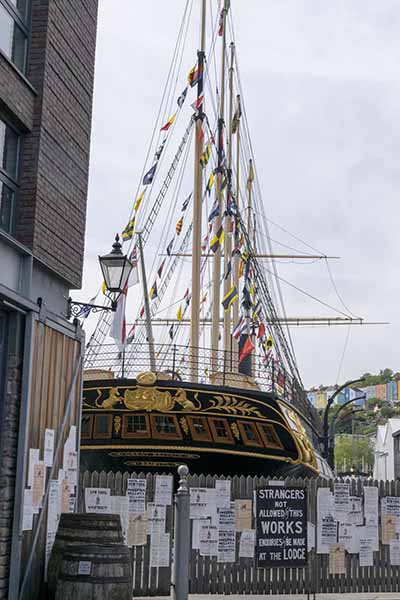 Bristol is the major city of the west country.
Clevedon is home to a wealth of Georgian, Regency and Victorian buildings, add in an elegant pier, bandstand and bowling greens and you have the quintessential charming seaside resort without the gaudy attractions that spoil so many resorts. The town has a literary connection with Tennyson, Coleridge and Thackerary being regular visitors, the connections being commemorated by Poet's Walk, following a cliff-top walk. Nearby Clevedon Court is where Thackerary wrote most of his epic Vanity Fair. The house also has a good exhibition of local glassware.
To reach the water at low tide requires a walk of almost a mile at Weston-super-Mare, however it is an adventure that is not recommended as the mud flats can be treacherous, it is much better to stick to the two miles of golden sands at the beach. Like many resorts Weston was a small, almost insignificant, fishing port until the arrival of the railway. the Victorians loved the place so much, they built two piers. All the usual attractions can be found here, without going over the top.
Burnham-on-Sea began to be popular when an attempt was to create a spa, the reception was mixed (one critic described the water "smelling like a cesspit combined with horseradish") the spa failed but it put Burnham on the map as a resort. A wooden, white and red, lighthouse sits on the beach. St Andrew's church is home to an amazing collection of cherubs and angels, salvaged from London's Whitehall Palace when it was destroyed by fire in 1698.
In Saxon days Watchet was a major port, so important it had its own mint, and the Market House Museum tells the story of the town. It still remains a port, although much smaller nowadays.
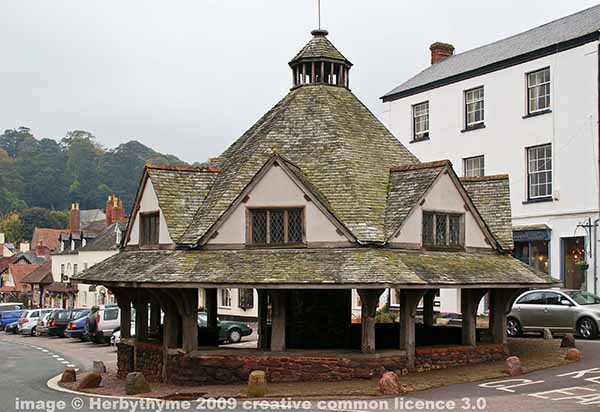 A walk through Dunster is like taking a walk through time with buildings dating back almost 800 years, many of them well preserved. There are too many interesting buildings to list here but it is suffice to say the place is an absolute delight.
Minehead has something for everyone. From a long esplanade, amusement arcades, holiday camps, funfairs and a mile of sandy beaches to delightful, tranquil gardens. Blenheim Gardens is host to Sunday concerts in the summer and beyond the park is a quieter part of town and the old harbour.
The big, novelty, attraction of Porlock is a clutch straining one-in-four (25%) gradient road, connecting the town with Exmoor. Nearby Porlock Weir has a small port with a few houses and a pub clustered on the quay.
Lynton is another clutch cruncher for your car with another one-in-four (25%) gradient connecting the town with its beach 500ft (152m) below, better still is leave the car in the town and catch the cliff railway, operated by counterbalanced water tanks. The area is so hilly the Victorians named it Little Switzerland.
Combe Martin is set in a deep valley and has England's longest high street at two miles long, leading to a sand and shingle beach. The village used to be a centre for silver and lead mining and a seafront museum tells the story. An up and down cliff walk to the east of the village offers some stunning views. There is a small motorcycle museum in the village.
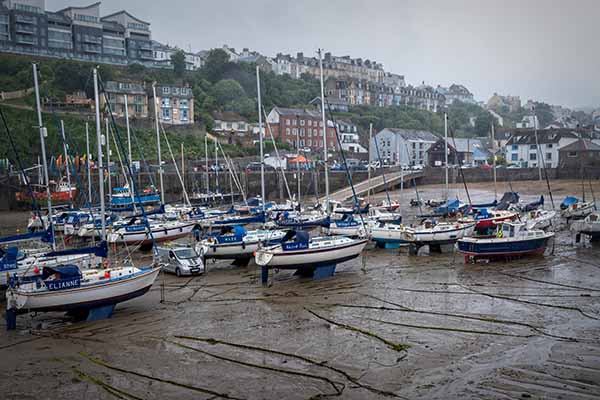 Ilfracombe offered rare shelter from storms along this stretch of coast, so the harbour has long been very popular. Now more popular with pleasure vessels there is still a small fishing fleet. The town is the largest resort in north Devon and another resort owing its popularity to the Victorians. Built on a hill overlooking the beach the town is home to two tidal basins which were used for single sex bathing in Victorian times but are now open to all. The various cliffs mean the town has a number of small beaches.
High dunes sit behind Woolacombe's sandy beaches and the area attracts both swimmers and surfers. By contrast Barricane beach to the north of the town consists almost entirely of shells carried across the Atlantic from the Caribbean.
The seafaring tradition at Appledore can be traced back almost 1,000 years
Prior to 1863 the town of Westward Ho! did not exist. The small, purpose built resort takes its name from Charles Kinksley's seafaring novel of the same name.
Clovelly is one of the classic, "must visit" towns in the area. The steep iconic, cobbled main street, flanked by whitewashed houses leads town to a stony beach. Vehicles are prohibited in the high street and the only way to move goods up and down the street is by donkey pulled sledges. In the summer a land rover provides a shuttle-service between the main car park and the harbour, avoiding the high street. The best way to approach the village is along a wooded toll-road off the A39.
Between Bude's two beaches is a natural seawater pool. Off the beaches it is sometimes possible to view dolphins. Nearby the Bude Canal is home to one of the last working sea locks in Britain.
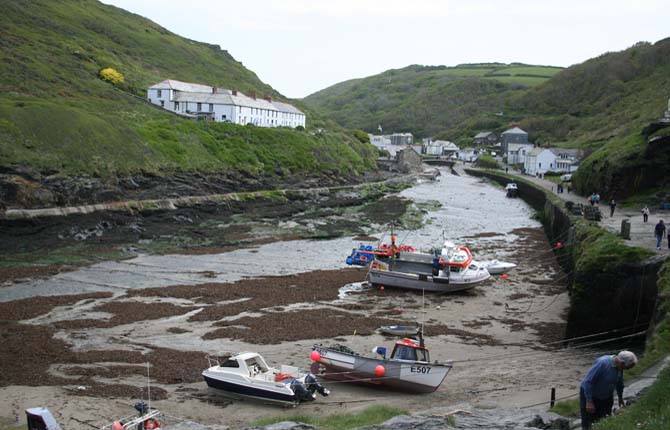 Boscastle is built on a long natural inlet which provided shelter for its small fishing fleet, nowadays tourism is the main earner for the village and well worth a visit. Walking from the village to the sea is a pleasant walk and at high tide the sea can sometimes be seen coming through blow holes. Although the inlet does provide shelter for boats it also has the disadvantage that it funnels water and the village has suffered some terrible flooding over the years.
Thanks to the fanciful musings of Tennyson, which linked the legend of King Arthur to the location, Tintagel has been a magnet for tourists. There is, of course, absolutely no evidence whatsoever that Arthur even visited Tintagel but why let the facts destroy what is a marketing managers dream. Legend or otherwise the location is stunning and awesome and it can bee seen why a connection has been made with the legend. "The Island" can best be reached by a 300 step winding wooden stairway and on the top of the craggy island are the remains of Tintagel Castle. As would be expected the nearby village has several attractions as they understandably cash in on the Arthurian story.
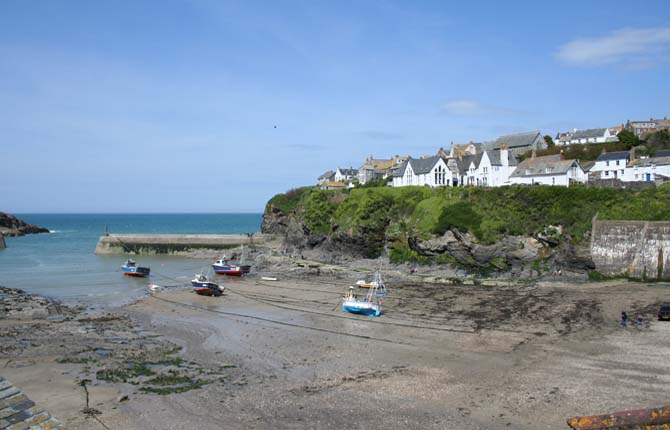 Any British TV viewers who enjoy soppy medical dramas and then visit Port Issac for the first time may well have a feeling of déjà-vu as the town is where the surprisingly popular TV series Doc Martin was filmed. Still an active fishing port the beach is also popular. It is possible to park on the beach at low tide but most visitors park in the main car park above the town and take the cliff walk into the town itself. There are plenty of narrow alleyways in the town, most notably the Squeeze-ee-belly Alley - I'll leave it to you to discover why it is so called.
Being west facing and having a curved sandy beach Polzeath is very popular with surfers.
Padstow has come into the public consciousness because it is the home of celebrity chef Rick Stein and his seafood restaurant, indeed he know owns several restaurants and shops in the town, cashing in on his notoriety, to the extent some of his detractors (and peeved locals) call the town Padstein. The town is still a busy fishing port with the main streets all converging on the harbour. The National Lobster Hatchery is located on the quayside and is open to visitors. Mayday sees the very popular 'Obby 'Oss parade which sees people parading in grotesque masks, followed by bands and dancers.
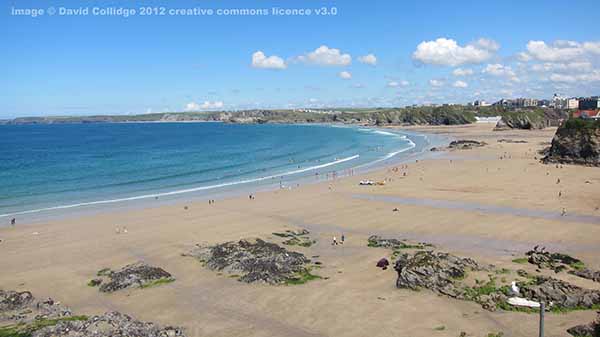 Between Padstow and Newquay there are a number of sandy coves, most of which offer safe bathing. Newquay's unofficial motto is "something for everyone" most notably surfers as Cornwall's largest resort is a mecca for surfers and home to many international surfing competitions. There are also spacious and popular bathing beaches and the harbour is festooned with lobster pots. The cliffs overlooking the town offering stunning views. Amongst the other attractions are a zoo, aquarium and sub-tropical gardens.
Perranporth is a former fishing and mining community, now a popular resort with two miles of beach, backed by dunes, most of it safe bathing water, although the area near Chapel Rock has some dangerous currents. There is a nature reserve nearby.
St Agnes is now quite a sleepy backwater but in days of yore it was a major mining centre, the story of which is told in the towns museum. St Agnes Beacon at 692ft (192m) above the sea offers stunning views and it is said, on a clear day, you can see 30 parish churches, both coasts of Cornwall and, at night, the beams of 12 lighthouses.
More delightful villages and coves line this stretch of coast until the next big town, St Ives, is reached. The town is has been popular with artists since the 1880's and is home to over 30 art galleries, including a branch of the Tate. Winding streets and sandy beaches makes the town popular with the less culturally refined visitors as well. One big advantage is traffic is prohibited in the town centre during the summer (large car parks are provided on the outskirts). One popular option is to park at the nearby town of Lelant and catch a train along a spectacular stretch of coastline.
Sennen Cove is a mile long surfing beach and its exposed location can result in some great breakers.
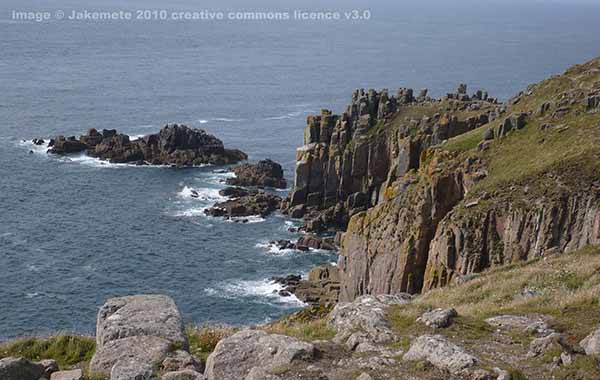 Land's End isn't quite the southern most point in mainland Britain but like its northern counterpart, John O'Groats it is close enough and it cashes in on its location. There used to be an admission charge for the site but this has, sensibly, been removed to be replaced by a more reasonable £5 all day parking charge, although a bit steep if you only want to spend a short time there. There are plenty of attractions on the site to try and make you dip your hands in your pocket but, at least, they are optional. There is a shopping village but it is not open every day - check before travelling if that is essential to your enjoyment. There is the famous signpost which, at a cost of course, can be personalised to your own requirements. Nearby Mill Bay and Porthgwarra are further south and are far less commercialised.
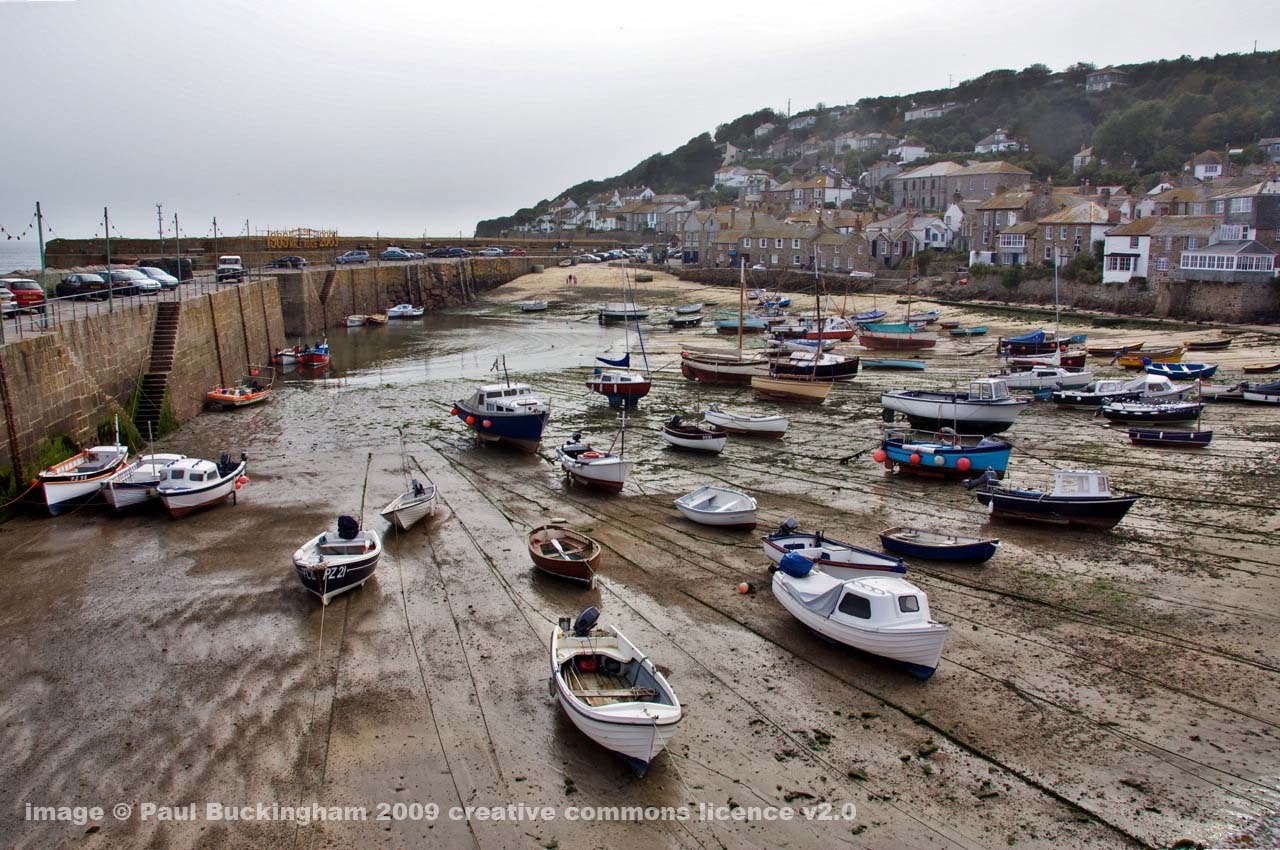 If you asked someone to describe what they think a typical Cornish fishing port would look like then Mousehole, pronounced "Mowzull", would be the port that is nearest to that image. Fishermens houses crowd around the harbour with its stone quays and a small stretch of sandy beach appears at low tide. Fishing trips are available from the harbour. At one time Mousehole was the main fishing port on the south Cornish coast but claim was superseded with the development of Newlyn, just along the coast. Like Mousehole stone cottages like the roads leading to the harbour, still home to a reasonable size fishing fleet. A fish festival takes place around the August Bank Holiday weekend and, although not as extensive as St Ives, the town does attract a large number of artists.
Penzance is no longer the major port it once was but the harbour still bustles with pleasure craft and is home to the ferry link to the Scilly Isles. A shingle beach links the town to Newlyn in the south whilst a sweeping sandy beach stretches for three miles in the other direction. There are plenty of interesting buildings in the town and a town trail takes in many of them and there are several museums. Nearby is Trengwainton, owned by the National trust and home to exotic gardens.
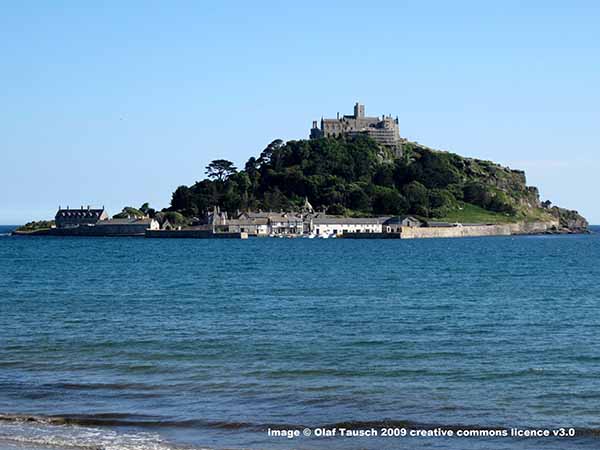 Marazion sits at the end of the three miles of sands from Penzance and the town itself would barely be mentioned if it were not for what lays in the bay just off the coast. St Michael's Mount is nowhere near as dramatic as its French counterpart but is impressive nonetheless. Sitting like a giant sandcastle the 300ft (91m) tall island is topped by the remains of a 14th century castle, itself built on the site of an earlier monastery. Now under the care of the National Trust parts of the castle and island are open to the public. Access is via a causeway at low tide or a ferry at other times. Opening times and days vary by season. More details here
Porthleven is home to a surprisingly large harbour, built by industrialists for the exporting of tin and importing of mining machinery. The port is popular with divers due to the number of nearby shipwrecks.
Lizard Point is further south than Lands End and is not commercialised at all, the powerful lighthouse throws a beam visible 21 miles away. The village is known for polishing the local serpentine rock.
Helford is a pretty village with thatched cottages and gardens which blaze with colour in the spring and summer months. The small port is now relatively quiet, a contrast to its heyday as a centre for the importation of tobacco, rum and lace.
A combination of its proximity to the Atlantic Ocean and being blessed with a large, sheltered natural harbour Falmouth was, for many years, the main port for trans-Atlantic shipping. The towns Maritime Museum has a feast of information on the towns nautical heritage. On one of the towns quays the Queens Pipe can be found, basically the remains of a chimney where contraband tobacco was burned. There are pleasure cruises from the port in the summer. There is more to Falmouth than the port and the town is home to some wide, sandy beaches.
St Mawes is found on the end of a peninsular across the water from Falmouth, to where there is a ferry connection. The busy harbour is shared by fishing and pleasure boats. The towns castle faces Falmouth's the other side of the water. Lamorran House Gardens are only open two days a week but the sub-tropical grounds are worth a visit.
Portloe has a very narrow entrance to its pretty harbour, lined with winches and lobster pots. The entrance is so narrow it is too dangerous for boats to attempt to enter in adverse weather conditions.
Mevagissey is still a working port but is also very much a tourist hotspot with numerous attractions, demonstrated amply in the main street which is populated by restaurants, bars, pubs and craft shops. The steep, narrow streets are not really suitable for cars and most visitors park in the large car parks on the outskirts of the town.
St Austell is a market town which owes its existence to kaolin (or china clay) used to make products as diverse as porcelain and paper. White quarry spoil heaps can be found north of the town and is home to the Wheal Martyn China Clay Heritage Centre, which has an 18ft (5m) water wheel as its main attraction.
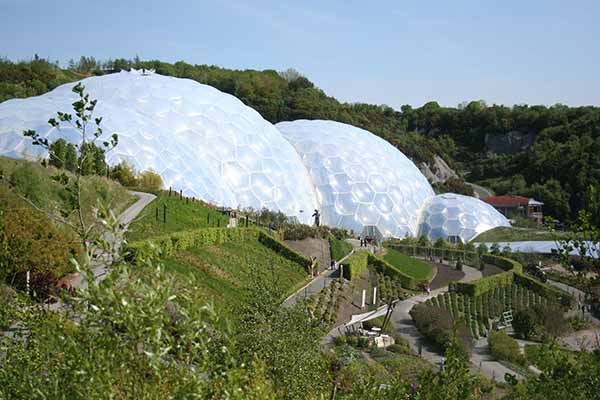 A former quarry 2½ miles north of the town has been radically transformed to create the Eden Project, home to the worlds biggest greenhouses or bio-domes. The domes at the site have become iconic and are almost as impressive from the outside as they are inside. Open 363 days a year the project is well worth a visit but allow at least half a day and bring stout walking shoes. 2015 Admission: Adult £25.00, Concessions £20.00 and Children £14.00. Discounts are available if booking online or if you arrive by cycle or public transport.
Fowey, pronounced "Foy" is a busy "short cut" on the coastal route with the car ferry cutting many miles off the coastal journey. Many people just pass through the town to use teh ferry but in doing so they are missing a pretty little town, including an interesting museum telling the history of china clay and shipping.
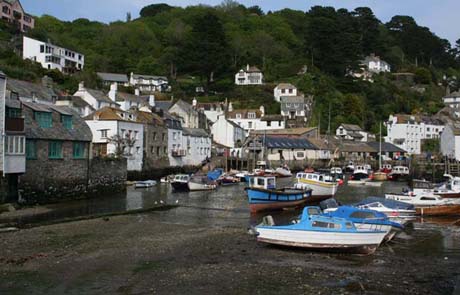 If you have a jigsaw of a Cornish fishing port then it's a fair chance it is of Polperro, certainly the most photographed of the Cornish ports. There is a large car park on the outskirts of the town (only residents are allowed to drive in the town) and it is then a good 15 minute walk or a ride on a shuttle minibus or horse drawn carriage to the harbour. There are plenty of touristy shops in the town, including an excellent home made ice cream shop but if shopping isn't your forte they can be ignored. the harbour is very photogenic and for the fleet footed a climb of Chapel Hill with give a good high level view of the harbour. For me Polperro is one of the "must see" towns in this part of the country.
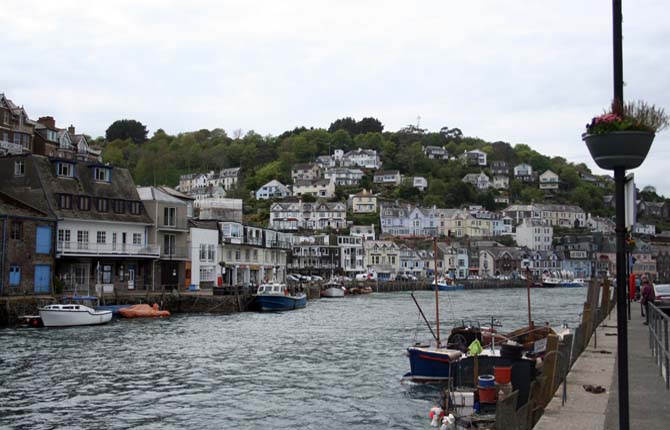 Looe is a town spilt in two by an estuary creating a town with two distinctive areas, indeed for over 500 years East and West Looe were two distinct towns. Nowadays West Looe is very much the residential area whilst East Looe with its narrow streets and beach is very much the tourist area. There is a daily fish market in East Looe and pleasure trips are available to the privately owned Looe Island, a haven for sea birds. Not a lot of people realise Looe has an alter-ego in the location of Shipton Abbot in the popular TV series Beyond Paradise.
Seaton has a lovely sandy beach, popular with bathers, divers and windsurfers, however the major attraction is the Monkey Sanctuary, open daily April - October, weekends in March.
Plymouth thinks it is the major Naval port in the country but coming from Portsmouth, which is the major port, I can tell them they are the second most important Naval base. It was atop Plymouth Hoe that Sir Francis Drake reputedly finished his game of bowls before setting off to sort out the Spanish. The centre of Plymouth has been almost completely rebuilt after being almost totally destroyed in the Second World War. Smeaton's Tower dominated the Hoe and fit visitors can climb the 93 steps for an impressive view.
The Royal Citadel overlooks Sutton Harbour home of a fish market and the Barbican area, a mainly pedestrianised area with cobble streets and home to the city's lively night life.
The Plymouth Gin Distillery offers guided tours. Harbour trips are available to see any vessels which may be in port.
KingsbridgeSalcombe is the gateway to a complex of natural harbours and creeks covering almost 2,000 acres. Very much a base for the sailing fraternity the towns streets throng with visitors in the summer. At the top end of one of the creeks is the town of Kingsbridge built around some quays, which drain at low tide. The town is home to the interesting Cookworthy Museum of Rural Life as well as a vintage cinema.
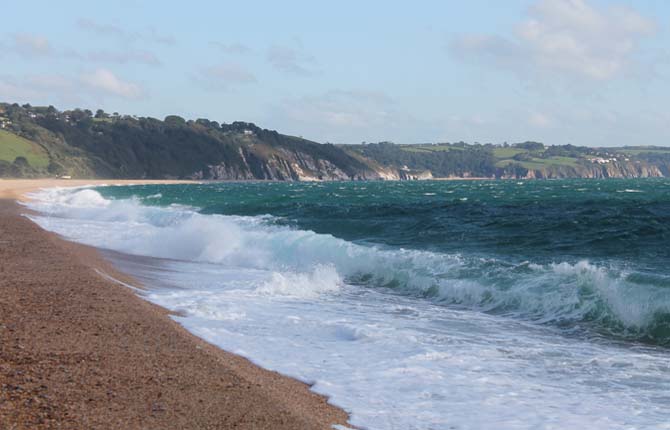 Back in 1944 Slapton beach was used as a "rehearsal" for the D-Day landings, commemorated by a granite monument. A road separates the shingle beach from Slapton Ley, a freshwater lake, a nature reserve.
Blackpool is an absolute contrast to its brash northern namesake with not a single amusement arcade or tat shop to be seen. Instead there is a small sandy cove with golden sands, a beach from which dogs are banned, all overlooked by wooded cliffs.
Built on the side of steep cliffs overlooking the River Dart and home to two car ferries cutting down the coastal journey, Dartmouth is a delightful town. Once a very prosperous port the town is best known as home to the Britannia Naval College a building which dominates the town.
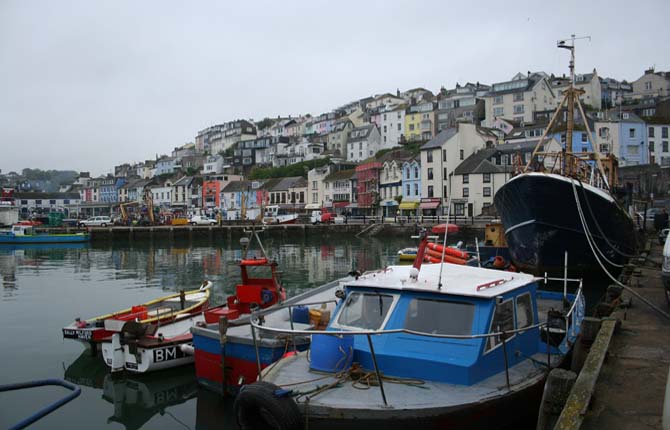 For over 300 years Brixham was England's major fishing port and is still home to a large fishing fleet as lobster pots line the quayside. The town slopes down steep hills surrounding the harbour. The harbour is home to a life size replica of the Golden Hind the vessel in which Sir Francis Drake sailed round the world and the small size of the ship really underlines just what an epic voyage it was. Nearby is the British Fisheries Museum which is , well a fishing museum! Boat trips are available for fishing or just sightseeing and there is a ferry service to Torquay.
Paignton is the smaller, more refined, neighbour of Torquay and is known for the brightly coloured beach huts which line the beach. One of the towns main attractions is its zoo.
Torquay has a very Mediterranean feel to it with its wide esplanade, palm trees and harbour thronged with pleasure craft. The town became popular when European wars prevented the wealthy holidaying in Europe in the early 19th century. The Mediterranean atmosphere is enhanced by Torquay, Brixham and Paignton being known as the "English Riviera" The beaches have more shingle than sand and there are the usual resort attractions but certainly not to the extent of other, more gaudy, resorts. Most water sports are catered for, including a reserved area for water skiing. Boat trips are plentiful, some going as far afield as the Channel Islands.
Babbercombe was a popular resort long before Torquay. Bygones is an attraction with a recreated Victorian Street, even recreating the smells of the time. There is a model village in the town as well. To access the beach you need to deal with a one-in-three (33%) road - or you can take a cable car!
Teignmouth was a port for the exporting of Dartmoor granite, some of which was used to build the old London Bridge (now in Arizona) and the British Museum. Now the port exports clay. A beach of red sand is backed by bowling greens, playgrounds and miniature golf courses.
Dawlish also has a red beach, it is also home to a magnificent stretch of railway which follows the coast and offers magnificent views. The track was severely damaged in the 2013-14 winter storms and is expected to reopen in the summer of 2014. The town hosts a very popular airshow every August.
Exmouth is a genteel resort where cliffs overlook two miles of sandy beaches. The town is home to a nature reserve and nearby A La Ronde is a unique 16 sided house whose interior is encrusted with shells.
Sidmouth is another resort without any of the brashness of others. Surrounded by red cliffs the shingle beach is, nonetheless, popular. There are some lovely manicured gardens behind the western end of the seafront. Nearby Salcombe Hill is home to an observatory with two 19th century telescopes.
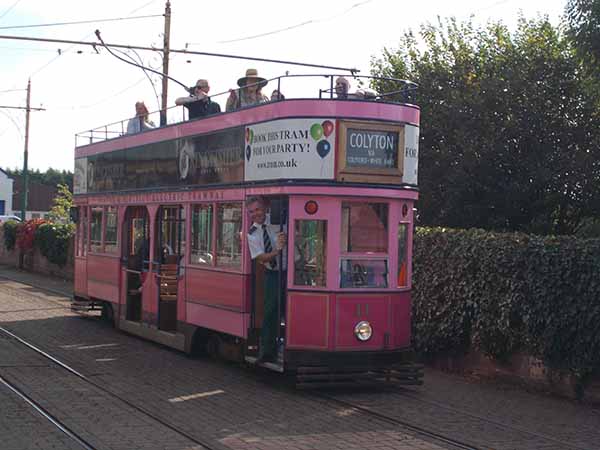 Continuing the run of sedate resorts Seaton has a mile long shingle beach and a few cafés along the front. It does, however, have a fantastic electric tramway which travels three miles inland, passing alongside mudflats, making the service popular with bird watchers. Allow a couple of hours for the trip and even if you don't stay long the other end, there is a delightful tearoom at the terminus.
In Roman times Axmouth was one of Britain's busiest ports but landslips blocked the river and the port was no more and the village, with thatched and colour washed cottages, is now a mile from the sea..
Lyme Regis has a respectable air but don't be fooled as its history is littered with tales of smuggling, battles and sieges. The Cobb, featuring in the film The French Lieutenants Woman, and dating back to the 14th century protects the harbour, now home to pleasure craft. In an area renown for fossils it's no surprise fossils feature heavily in the towns Museum. Lyme Regis is a sublime town, a bit hilly but with plenty of seafood restaurants for those who like piscean eating. Apparently 75% of visitors to the region visit Lyme Regis.
Chesil Beach is a 17 mile long spit enclosing a lagoon known as The Fleet. With fine gravel at the western end by the time it reaches Portland at it's western end the gravel has become much larger. The lagoon is a nature reserve and part of the beach is closed from May to August to protect nests. Abbosbury is at the western end, although there is little there, apart from a very expensive car park, although half a mile inland are Abbotsbury Gardens.
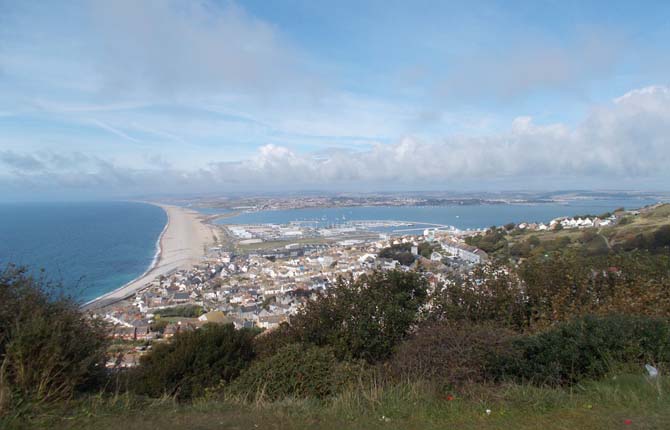 Portland, renown for its famous pale coloured stone, used in the building of St Paul's Cathedral and Buckingham Palace amongst many others, is at the eastern end of Chesil Beach and well worth a visit. There are many fantastic viewing points offering stunning views along the coast and at Portland Bill there is the famous lighthouse. There is a café at Portland Bill offering great views from the terrace, although the menu is limited.
It was George III who made Weymouth popular as he came to take the sea air to aid his health in the late 18th early 19th centuries, in 1789 he became the first monarch to use a bathing machine on the beach and it's no surprise a replica bathing machine take pride of place on one of the towns roundabouts. The wide sandy beach is edged with an esplanade with hotels and guest houses. Walk beyond the Bay and you will reach the harbour which has a distinct French feel to it (and it is surprisingly large)
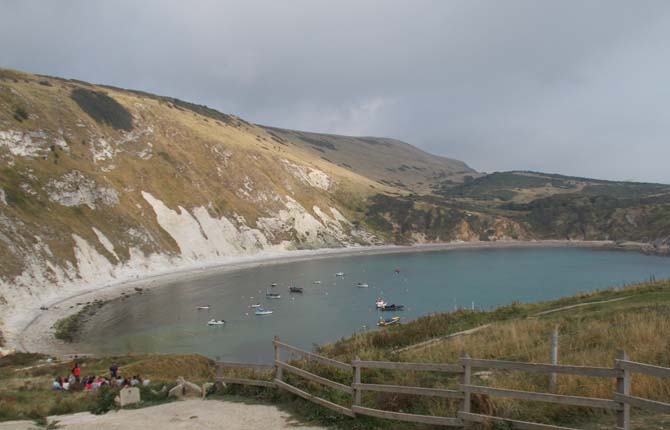 Lulworth Cove appears in many geography and geology textbooks as the perfect example of the battle between the sea and rocks and the results of coastal erosion. A large car park gives visitors two options. Either a gentle walk down to the cove itself or a cliff climb offering a "top down" view of the Bay - both are worth it. For the more energetic there is a coastal walk to nearby Durdle Dore. If you don't fancy the walk parking tickets at Durdle Dore and Lulworth are interchangable, so only one set of parking needs to be paid for.
Swanage is a small resort, popular with anglers and pleasure boats. The towns diving school is one of the oldest in the country. Due to its location Swanage is one of those places you tend not to stumble across but it is well worth a visit. The beach and town are lovely, nothing "in your face" about the place and the beach is lovely and sunny - it's no surprise this is a resort many people visit time and time again.
Poole is at the top end of Poole Harbour, the largest natural harbour in Europe with 90 miles of coastline and 14 square miles of water. In the middle of the harbour is Brownsea Island, now a nature reserve, but in 1907 the site of Lord Baden Powell's first Boy Scout camp. The town itself has three miles of sandy beaches. The quayside is lined by Georgian buildings and is home to Poole Pottery. For garden lovers nearby Compton Acres are well worth a visit.
Yet another resort to be developed as a result of the railway boom, Bournemouth is home to seven miles of sandy beaches, not to mention two piers and a splendid promenade. The Chines, valleys in the cliffs, were used by smugglers in days of yore. Nowadays Bournemouth as all the attractions you would expect in a modern resort. However in addition to he usual attractions Bournemouth has some splendid gardens, many of them located in the various Chines as well as more formal gardens in the town centre. The towns museum is also home to the renown Russell-Coates Art Gallery. The town's Pavilion includes a ballroom and theatre.
If you like visiting churches then Christchurch Priory is worth a visit. At 312ft (91m) it is the longest church in England, longer than moat cathedrals. An interesting town trail tells the story of Christchurch and takes in some notable old buildings.
Lymington is the unofficial "capital" of the New Forest and has had a Royal Charter since the 10th Century and the towns still hosts a popular Sunday market along the high street. One of the crossing points for the Isle Of Wight the town is popular and a good base from which to explore the New Forest. Near the harbour is the Old Town, a hilly cobbled street with a collection of gift shops and restaurants.
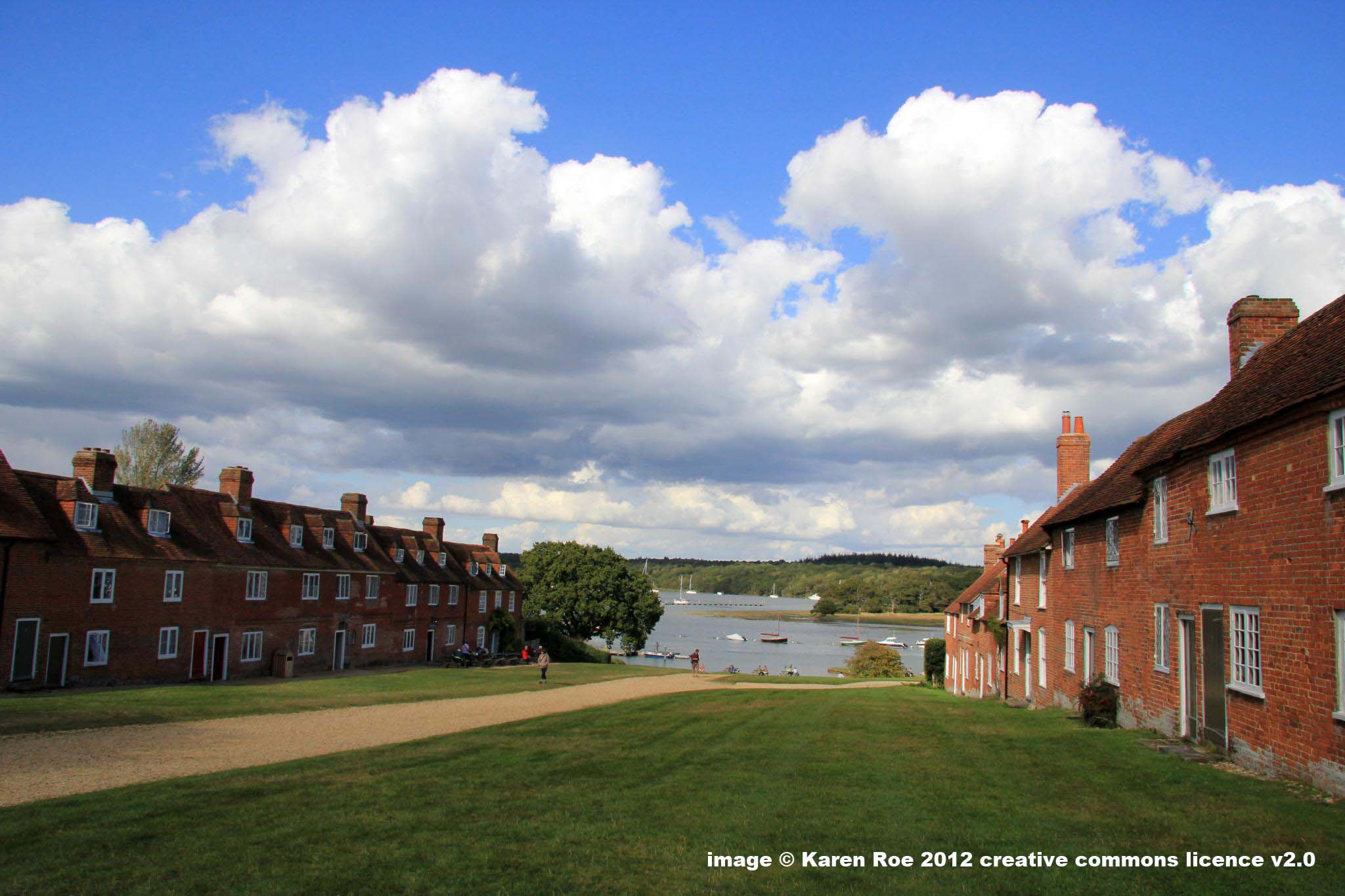 Bucklers Hard is "just" two rows of cottages separated by a grassy High Street, the village was once a major shipbuilding centre, using oak from the nearby New Forest. There is a fee to enter the village, which includes admission to the Maritime Museum. River cruises are available from the jetty. Two and a half miles along the river is Beaulieu, home to the famous motor museum, although the village itself is also delightful.
Southampton is the country's major passenger port and although the glory days of ocean going liners are long gone, several cruise and transatlantic liners can be seen at the port every week. It was from Southampton that the Titanic set off on its fateful voyage in 1912 and the story is told in the Maritime Museum. Southampton was heavily bombed in the Second World War but some of the old city walls still remain intact. Some of the old docks have been redeveloped to form Ocean Village and the city is a magnet for shoppers. Whilst another area of redeveloped docks, Town Quay, has a Sunday market which sometimes attracts traders from France.
Hamble is the most concentrated sailing centres in the country, with now fewer than five marinas and numerous shipyards. The town was used as the setting of the popular 1980's TV series Howards Way.
Lee-on-the-Solent has a long shingle beach with a couple of amusement parks. It offers good views of the Isle Of Wight and is a great, but very popular, vantage point for watching the huge fireworks display which closes Cowes Week in August. There is a hovercraft museum in the town.
Gosport was originally called God's Port and it forms one side of the narrow entrance to Portsmouth Harbour. A ferry service has operated across the harbour to Portsmouth since the reign of Edward I. HMS Dolphin was a major submarine training base for the Royal Navy and is home to the Submarine Museum which includes Holland I, the first submarine used by the Navy, more modern submarines can also be explored.
Portchester is located at the top of Portsmouth Harbour and is home to the most complete, surviving Roman Fortress in Europe.
Nearby Portsdown Hill offers splendid views of Portsmouth and the Isle of Wight and on a clear day you can see as far as Chichester to the east and Southampton to the west.
Previous: Flint - Chepstow Next: Portsmouth - Dover
Bristol is the major city of the west country.Clevedon is home to a wealth of Georgian, Regency and Victorian buildings, add in an elegant pier, bandstand and bowling greens and you have the quintessential charming seaside resort without the gaudy attractions that spoil so many resorts. The town has a literary connection with Tennyson, Coleridge and Thackerary being regular visitors, the connections being commemorated by Poet's Walk, following a cliff-top walk. Nearby Clevedon Court is where Thackerary wrote most of his epic Vanity Fair. The house also has a good exhibition of local glassware.
To reach the water at low tide requires a walk of almost a mile at Weston-super-Mare, however it is an adventure that is not recommended as the mud flats can be treacherous, it is much better to stick to the two miles of golden sands at the beach. Like many resorts Weston was a small, almost insignificant, fishing port until the arrival of the railway. the Victorians loved the place so much, they built two piers. All the usual attractions can be found here, without going over the top.
Burnham-on-Sea began to be popular when an attempt was to create a spa, the reception was mixed (one critic described the water "smelling like a cesspit combined with horseradish") the spa failed but it put Burnham on the map as a resort. A wooden, white and red, lighthouse sits on the beach. St Andrew's church is home to an amazing collection of cherubs and angels, salvaged from London's Whitehall Palace when it was destroyed by fire in 1698.
In Saxon days Watchet was a major port, so important it had its own mint, and the Market House Museum tells the story of the town. It still remains a port, although much smaller nowadays.
A walk through Dunster is like taking a walk through time with buildings dating back almost 800 years, many of them well preserved. There are too many interesting buildings to list here but it is suffice to say the place is an absolute delight.Minehead has something for everyone. From a long esplanade, amusement arcades, holiday camps, funfairs and a mile of sandy beaches to delightful, tranquil gardens. Blenheim Gardens is host to Sunday concerts in the summer and beyond the park is a quieter part of town and the old harbour.
The big, novelty, attraction of Porlock is a clutch straining one-in-four (25%) gradient road, connecting the town with Exmoor. Nearby Porlock Weir has a small port with a few houses and a pub clustered on the quay.
Lynton is another clutch cruncher for your car with another one-in-four (25%) gradient connecting the town with its beach 500ft (152m) below, better still is leave the car in the town and catch the cliff railway, operated by counterbalanced water tanks. The area is so hilly the Victorians named it Little Switzerland.
Combe Martin is set in a deep valley and has England's longest high street at two miles long, leading to a sand and shingle beach. The village used to be a centre for silver and lead mining and a seafront museum tells the story. An up and down cliff walk to the east of the village offers some stunning views. There is a small motorcycle museum in the village.
Ilfracombe offered rare shelter from storms along this stretch of coast, so the harbour has long been very popular. Now more popular with pleasure vessels there is still a small fishing fleet. The town is the largest resort in north Devon and another resort owing its popularity to the Victorians. Built on a hill overlooking the beach the town is home to two tidal basins which were used for single sex bathing in Victorian times but are now open to all. The various cliffs mean the town has a number of small beaches.High dunes sit behind Woolacombe's sandy beaches and the area attracts both swimmers and surfers. By contrast Barricane beach to the north of the town consists almost entirely of shells carried across the Atlantic from the Caribbean.
The seafaring tradition at Appledore can be traced back almost 1,000 years
Prior to 1863 the town of Westward Ho! did not exist. The small, purpose built resort takes its name from Charles Kinksley's seafaring novel of the same name.
Clovelly is one of the classic, "must visit" towns in the area. The steep iconic, cobbled main street, flanked by whitewashed houses leads town to a stony beach. Vehicles are prohibited in the high street and the only way to move goods up and down the street is by donkey pulled sledges. In the summer a land rover provides a shuttle-service between the main car park and the harbour, avoiding the high street. The best way to approach the village is along a wooded toll-road off the A39.
Between Bude's two beaches is a natural seawater pool. Off the beaches it is sometimes possible to view dolphins. Nearby the Bude Canal is home to one of the last working sea locks in Britain.
Boscastle is built on a long natural inlet which provided shelter for its small fishing fleet, nowadays tourism is the main earner for the village and well worth a visit. Walking from the village to the sea is a pleasant walk and at high tide the sea can sometimes be seen coming through blow holes. Although the inlet does provide shelter for boats it also has the disadvantage that it funnels water and the village has suffered some terrible flooding over the years. Thanks to the fanciful musings of Tennyson, which linked the legend of King Arthur to the location, Tintagel has been a magnet for tourists. There is, of course, absolutely no evidence whatsoever that Arthur even visited Tintagel but why let the facts destroy what is a marketing managers dream. Legend or otherwise the location is stunning and awesome and it can bee seen why a connection has been made with the legend. "The Island" can best be reached by a 300 step winding wooden stairway and on the top of the craggy island are the remains of Tintagel Castle. As would be expected the nearby village has several attractions as they understandably cash in on the Arthurian story.
Any British TV viewers who enjoy soppy medical dramas and then visit Port Issac for the first time may well have a feeling of déjà-vu as the town is where the surprisingly popular TV series Doc Martin was filmed. Still an active fishing port the beach is also popular. It is possible to park on the beach at low tide but most visitors park in the main car park above the town and take the cliff walk into the town itself. There are plenty of narrow alleyways in the town, most notably the Squeeze-ee-belly Alley - I'll leave it to you to discover why it is so called.Being west facing and having a curved sandy beach Polzeath is very popular with surfers.
Padstow has come into the public consciousness because it is the home of celebrity chef Rick Stein and his seafood restaurant, indeed he know owns several restaurants and shops in the town, cashing in on his notoriety, to the extent some of his detractors (and peeved locals) call the town Padstein. The town is still a busy fishing port with the main streets all converging on the harbour. The National Lobster Hatchery is located on the quayside and is open to visitors. Mayday sees the very popular 'Obby 'Oss parade which sees people parading in grotesque masks, followed by bands and dancers.
Between Padstow and Newquay there are a number of sandy coves, most of which offer safe bathing. Newquay's unofficial motto is "something for everyone" most notably surfers as Cornwall's largest resort is a mecca for surfers and home to many international surfing competitions. There are also spacious and popular bathing beaches and the harbour is festooned with lobster pots. The cliffs overlooking the town offering stunning views. Amongst the other attractions are a zoo, aquarium and sub-tropical gardens.Perranporth is a former fishing and mining community, now a popular resort with two miles of beach, backed by dunes, most of it safe bathing water, although the area near Chapel Rock has some dangerous currents. There is a nature reserve nearby.
St Agnes is now quite a sleepy backwater but in days of yore it was a major mining centre, the story of which is told in the towns museum. St Agnes Beacon at 692ft (192m) above the sea offers stunning views and it is said, on a clear day, you can see 30 parish churches, both coasts of Cornwall and, at night, the beams of 12 lighthouses.
More delightful villages and coves line this stretch of coast until the next big town, St Ives, is reached. The town is has been popular with artists since the 1880's and is home to over 30 art galleries, including a branch of the Tate. Winding streets and sandy beaches makes the town popular with the less culturally refined visitors as well. One big advantage is traffic is prohibited in the town centre during the summer (large car parks are provided on the outskirts). One popular option is to park at the nearby town of Lelant and catch a train along a spectacular stretch of coastline.
Sennen Cove is a mile long surfing beach and its exposed location can result in some great breakers.
Land's End isn't quite the southern most point in mainland Britain but like its northern counterpart, John O'Groats it is close enough and it cashes in on its location. There used to be an admission charge for the site but this has, sensibly, been removed to be replaced by a more reasonable £5 all day parking charge, although a bit steep if you only want to spend a short time there. There are plenty of attractions on the site to try and make you dip your hands in your pocket but, at least, they are optional. There is a shopping village but it is not open every day - check before travelling if that is essential to your enjoyment. There is the famous signpost which, at a cost of course, can be personalised to your own requirements. Nearby Mill Bay and Porthgwarra are further south and are far less commercialised.If you asked someone to describe what they think a typical Cornish fishing port would look like then Mousehole, pronounced "Mowzull", would be the port that is nearest to that image. Fishermens houses crowd around the harbour with its stone quays and a small stretch of sandy beach appears at low tide. Fishing trips are available from the harbour. At one time Mousehole was the main fishing port on the south Cornish coast but claim was superseded with the development of Newlyn, just along the coast. Like Mousehole stone cottages like the roads leading to the harbour, still home to a reasonable size fishing fleet. A fish festival takes place around the August Bank Holiday weekend and, although not as extensive as St Ives, the town does attract a large number of artists. Penzance is no longer the major port it once was but the harbour still bustles with pleasure craft and is home to the ferry link to the Scilly Isles. A shingle beach links the town to Newlyn in the south whilst a sweeping sandy beach stretches for three miles in the other direction. There are plenty of interesting buildings in the town and a town trail takes in many of them and there are several museums. Nearby is Trengwainton, owned by the National trust and home to exotic gardens.
Marazion sits at the end of the three miles of sands from Penzance and the town itself would barely be mentioned if it were not for what lays in the bay just off the coast. St Michael's Mount is nowhere near as dramatic as its French counterpart but is impressive nonetheless. Sitting like a giant sandcastle the 300ft (91m) tall island is topped by the remains of a 14th century castle, itself built on the site of an earlier monastery. Now under the care of the National Trust parts of the castle and island are open to the public. Access is via a causeway at low tide or a ferry at other times. Opening times and days vary by season. More details herePorthleven is home to a surprisingly large harbour, built by industrialists for the exporting of tin and importing of mining machinery. The port is popular with divers due to the number of nearby shipwrecks.
Lizard Point is further south than Lands End and is not commercialised at all, the powerful lighthouse throws a beam visible 21 miles away. The village is known for polishing the local serpentine rock.
Helford is a pretty village with thatched cottages and gardens which blaze with colour in the spring and summer months. The small port is now relatively quiet, a contrast to its heyday as a centre for the importation of tobacco, rum and lace.
A combination of its proximity to the Atlantic Ocean and being blessed with a large, sheltered natural harbour Falmouth was, for many years, the main port for trans-Atlantic shipping. The towns Maritime Museum has a feast of information on the towns nautical heritage. On one of the towns quays the Queens Pipe can be found, basically the remains of a chimney where contraband tobacco was burned. There are pleasure cruises from the port in the summer. There is more to Falmouth than the port and the town is home to some wide, sandy beaches.
St Mawes is found on the end of a peninsular across the water from Falmouth, to where there is a ferry connection. The busy harbour is shared by fishing and pleasure boats. The towns castle faces Falmouth's the other side of the water. Lamorran House Gardens are only open two days a week but the sub-tropical grounds are worth a visit.
Portloe has a very narrow entrance to its pretty harbour, lined with winches and lobster pots. The entrance is so narrow it is too dangerous for boats to attempt to enter in adverse weather conditions.
Mevagissey is still a working port but is also very much a tourist hotspot with numerous attractions, demonstrated amply in the main street which is populated by restaurants, bars, pubs and craft shops. The steep, narrow streets are not really suitable for cars and most visitors park in the large car parks on the outskirts of the town.
St Austell is a market town which owes its existence to kaolin (or china clay) used to make products as diverse as porcelain and paper. White quarry spoil heaps can be found north of the town and is home to the Wheal Martyn China Clay Heritage Centre, which has an 18ft (5m) water wheel as its main attraction.
A former quarry 2½ miles north of the town has been radically transformed to create the Eden Project, home to the worlds biggest greenhouses or bio-domes. The domes at the site have become iconic and are almost as impressive from the outside as they are inside. Open 363 days a year the project is well worth a visit but allow at least half a day and bring stout walking shoes. 2015 Admission: Adult £25.00, Concessions £20.00 and Children £14.00. Discounts are available if booking online or if you arrive by cycle or public transport.Fowey, pronounced "Foy" is a busy "short cut" on the coastal route with the car ferry cutting many miles off the coastal journey. Many people just pass through the town to use teh ferry but in doing so they are missing a pretty little town, including an interesting museum telling the history of china clay and shipping.
If you have a jigsaw of a Cornish fishing port then it's a fair chance it is of Polperro, certainly the most photographed of the Cornish ports. There is a large car park on the outskirts of the town (only residents are allowed to drive in the town) and it is then a good 15 minute walk or a ride on a shuttle minibus or horse drawn carriage to the harbour. There are plenty of touristy shops in the town, including an excellent home made ice cream shop but if shopping isn't your forte they can be ignored. the harbour is very photogenic and for the fleet footed a climb of Chapel Hill with give a good high level view of the harbour. For me Polperro is one of the "must see" towns in this part of the country.Looe is a town spilt in two by an estuary creating a town with two distinctive areas, indeed for over 500 years East and West Looe were two distinct towns. Nowadays West Looe is very much the residential area whilst East Looe with its narrow streets and beach is very much the tourist area. There is a daily fish market in East Looe and pleasure trips are available to the privately owned Looe Island, a haven for sea birds. Not a lot of people realise Looe has an alter-ego in the location of Shipton Abbot in the popular TV series Beyond Paradise.Seaton has a lovely sandy beach, popular with bathers, divers and windsurfers, however the major attraction is the Monkey Sanctuary, open daily April - October, weekends in March.
Plymouth thinks it is the major Naval port in the country but coming from Portsmouth, which is the major port, I can tell them they are the second most important Naval base. It was atop Plymouth Hoe that Sir Francis Drake reputedly finished his game of bowls before setting off to sort out the Spanish. The centre of Plymouth has been almost completely rebuilt after being almost totally destroyed in the Second World War. Smeaton's Tower dominated the Hoe and fit visitors can climb the 93 steps for an impressive view.
The Royal Citadel overlooks Sutton Harbour home of a fish market and the Barbican area, a mainly pedestrianised area with cobble streets and home to the city's lively night life.
The Plymouth Gin Distillery offers guided tours. Harbour trips are available to see any vessels which may be in port.
KingsbridgeSalcombe is the gateway to a complex of natural harbours and creeks covering almost 2,000 acres. Very much a base for the sailing fraternity the towns streets throng with visitors in the summer. At the top end of one of the creeks is the town of Kingsbridge built around some quays, which drain at low tide. The town is home to the interesting Cookworthy Museum of Rural Life as well as a vintage cinema.
Back in 1944 Slapton beach was used as a "rehearsal" for the D-Day landings, commemorated by a granite monument. A road separates the shingle beach from Slapton Ley, a freshwater lake, a nature reserve.Blackpool is an absolute contrast to its brash northern namesake with not a single amusement arcade or tat shop to be seen. Instead there is a small sandy cove with golden sands, a beach from which dogs are banned, all overlooked by wooded cliffs.
Built on the side of steep cliffs overlooking the River Dart and home to two car ferries cutting down the coastal journey, Dartmouth is a delightful town. Once a very prosperous port the town is best known as home to the Britannia Naval College a building which dominates the town.
For over 300 years Brixham was England's major fishing port and is still home to a large fishing fleet as lobster pots line the quayside. The town slopes down steep hills surrounding the harbour. The harbour is home to a life size replica of the Golden Hind the vessel in which Sir Francis Drake sailed round the world and the small size of the ship really underlines just what an epic voyage it was. Nearby is the British Fisheries Museum which is , well a fishing museum! Boat trips are available for fishing or just sightseeing and there is a ferry service to Torquay.Paignton is the smaller, more refined, neighbour of Torquay and is known for the brightly coloured beach huts which line the beach. One of the towns main attractions is its zoo.
Torquay has a very Mediterranean feel to it with its wide esplanade, palm trees and harbour thronged with pleasure craft. The town became popular when European wars prevented the wealthy holidaying in Europe in the early 19th century. The Mediterranean atmosphere is enhanced by Torquay, Brixham and Paignton being known as the "English Riviera" The beaches have more shingle than sand and there are the usual resort attractions but certainly not to the extent of other, more gaudy, resorts. Most water sports are catered for, including a reserved area for water skiing. Boat trips are plentiful, some going as far afield as the Channel Islands.
Babbercombe was a popular resort long before Torquay. Bygones is an attraction with a recreated Victorian Street, even recreating the smells of the time. There is a model village in the town as well. To access the beach you need to deal with a one-in-three (33%) road - or you can take a cable car!
Teignmouth was a port for the exporting of Dartmoor granite, some of which was used to build the old London Bridge (now in Arizona) and the British Museum. Now the port exports clay. A beach of red sand is backed by bowling greens, playgrounds and miniature golf courses.
Dawlish also has a red beach, it is also home to a magnificent stretch of railway which follows the coast and offers magnificent views. The track was severely damaged in the 2013-14 winter storms and is expected to reopen in the summer of 2014. The town hosts a very popular airshow every August.
Exmouth is a genteel resort where cliffs overlook two miles of sandy beaches. The town is home to a nature reserve and nearby A La Ronde is a unique 16 sided house whose interior is encrusted with shells.
Sidmouth is another resort without any of the brashness of others. Surrounded by red cliffs the shingle beach is, nonetheless, popular. There are some lovely manicured gardens behind the western end of the seafront. Nearby Salcombe Hill is home to an observatory with two 19th century telescopes.
Continuing the run of sedate resorts Seaton has a mile long shingle beach and a few cafés along the front. It does, however, have a fantastic electric tramway which travels three miles inland, passing alongside mudflats, making the service popular with bird watchers. Allow a couple of hours for the trip and even if you don't stay long the other end, there is a delightful tearoom at the terminus.In Roman times Axmouth was one of Britain's busiest ports but landslips blocked the river and the port was no more and the village, with thatched and colour washed cottages, is now a mile from the sea..
Lyme Regis has a respectable air but don't be fooled as its history is littered with tales of smuggling, battles and sieges. The Cobb, featuring in the film The French Lieutenants Woman, and dating back to the 14th century protects the harbour, now home to pleasure craft. In an area renown for fossils it's no surprise fossils feature heavily in the towns Museum. Lyme Regis is a sublime town, a bit hilly but with plenty of seafood restaurants for those who like piscean eating. Apparently 75% of visitors to the region visit Lyme Regis.
Chesil Beach is a 17 mile long spit enclosing a lagoon known as The Fleet. With fine gravel at the western end by the time it reaches Portland at it's western end the gravel has become much larger. The lagoon is a nature reserve and part of the beach is closed from May to August to protect nests. Abbosbury is at the western end, although there is little there, apart from a very expensive car park, although half a mile inland are Abbotsbury Gardens.
Portland, renown for its famous pale coloured stone, used in the building of St Paul's Cathedral and Buckingham Palace amongst many others, is at the eastern end of Chesil Beach and well worth a visit. There are many fantastic viewing points offering stunning views along the coast and at Portland Bill there is the famous lighthouse. There is a café at Portland Bill offering great views from the terrace, although the menu is limited.It was George III who made Weymouth popular as he came to take the sea air to aid his health in the late 18th early 19th centuries, in 1789 he became the first monarch to use a bathing machine on the beach and it's no surprise a replica bathing machine take pride of place on one of the towns roundabouts. The wide sandy beach is edged with an esplanade with hotels and guest houses. Walk beyond the Bay and you will reach the harbour which has a distinct French feel to it (and it is surprisingly large)
Lulworth Cove appears in many geography and geology textbooks as the perfect example of the battle between the sea and rocks and the results of coastal erosion. A large car park gives visitors two options. Either a gentle walk down to the cove itself or a cliff climb offering a "top down" view of the Bay - both are worth it. For the more energetic there is a coastal walk to nearby Durdle Dore. If you don't fancy the walk parking tickets at Durdle Dore and Lulworth are interchangable, so only one set of parking needs to be paid for.Swanage is a small resort, popular with anglers and pleasure boats. The towns diving school is one of the oldest in the country. Due to its location Swanage is one of those places you tend not to stumble across but it is well worth a visit. The beach and town are lovely, nothing "in your face" about the place and the beach is lovely and sunny - it's no surprise this is a resort many people visit time and time again.
Poole is at the top end of Poole Harbour, the largest natural harbour in Europe with 90 miles of coastline and 14 square miles of water. In the middle of the harbour is Brownsea Island, now a nature reserve, but in 1907 the site of Lord Baden Powell's first Boy Scout camp. The town itself has three miles of sandy beaches. The quayside is lined by Georgian buildings and is home to Poole Pottery. For garden lovers nearby Compton Acres are well worth a visit.
Yet another resort to be developed as a result of the railway boom, Bournemouth is home to seven miles of sandy beaches, not to mention two piers and a splendid promenade. The Chines, valleys in the cliffs, were used by smugglers in days of yore. Nowadays Bournemouth as all the attractions you would expect in a modern resort. However in addition to he usual attractions Bournemouth has some splendid gardens, many of them located in the various Chines as well as more formal gardens in the town centre. The towns museum is also home to the renown Russell-Coates Art Gallery. The town's Pavilion includes a ballroom and theatre.
If you like visiting churches then Christchurch Priory is worth a visit. At 312ft (91m) it is the longest church in England, longer than moat cathedrals. An interesting town trail tells the story of Christchurch and takes in some notable old buildings.
Lymington is the unofficial "capital" of the New Forest and has had a Royal Charter since the 10th Century and the towns still hosts a popular Sunday market along the high street. One of the crossing points for the Isle Of Wight the town is popular and a good base from which to explore the New Forest. Near the harbour is the Old Town, a hilly cobbled street with a collection of gift shops and restaurants.
Bucklers Hard is "just" two rows of cottages separated by a grassy High Street, the village was once a major shipbuilding centre, using oak from the nearby New Forest. There is a fee to enter the village, which includes admission to the Maritime Museum. River cruises are available from the jetty. Two and a half miles along the river is Beaulieu, home to the famous motor museum, although the village itself is also delightful.Southampton is the country's major passenger port and although the glory days of ocean going liners are long gone, several cruise and transatlantic liners can be seen at the port every week. It was from Southampton that the Titanic set off on its fateful voyage in 1912 and the story is told in the Maritime Museum. Southampton was heavily bombed in the Second World War but some of the old city walls still remain intact. Some of the old docks have been redeveloped to form Ocean Village and the city is a magnet for shoppers. Whilst another area of redeveloped docks, Town Quay, has a Sunday market which sometimes attracts traders from France.
Hamble is the most concentrated sailing centres in the country, with now fewer than five marinas and numerous shipyards. The town was used as the setting of the popular 1980's TV series Howards Way.
Lee-on-the-Solent has a long shingle beach with a couple of amusement parks. It offers good views of the Isle Of Wight and is a great, but very popular, vantage point for watching the huge fireworks display which closes Cowes Week in August. There is a hovercraft museum in the town.
Gosport was originally called God's Port and it forms one side of the narrow entrance to Portsmouth Harbour. A ferry service has operated across the harbour to Portsmouth since the reign of Edward I. HMS Dolphin was a major submarine training base for the Royal Navy and is home to the Submarine Museum which includes Holland I, the first submarine used by the Navy, more modern submarines can also be explored.
Portchester is located at the top of Portsmouth Harbour and is home to the most complete, surviving Roman Fortress in Europe.
Nearby Portsdown Hill offers splendid views of Portsmouth and the Isle of Wight and on a clear day you can see as far as Chichester to the east and Southampton to the west.
Previous: Flint - Chepstow Next: Portsmouth - Dover