
Coast - Flint to Chepstow
This section of the coastal tour takes in the Welsh coastline. Beginning with the coastal towns in the north, passing the edge of Snowdonia.
Followed by the rugged west coast then the industry of the south, interspersed with the likes of the Gower.
Clicking location names highlighted in bold purple will open a new page with more detailed information
Prices quoted are correct as of May 2026
Followed by the rugged west coast then the industry of the south, interspersed with the likes of the Gower.
Clicking location names highlighted in bold purple will open a new page with more detailed information
Prices quoted are correct as of May 2026
Previous: Silloth - Hoylake Next: Bristol - Portchester
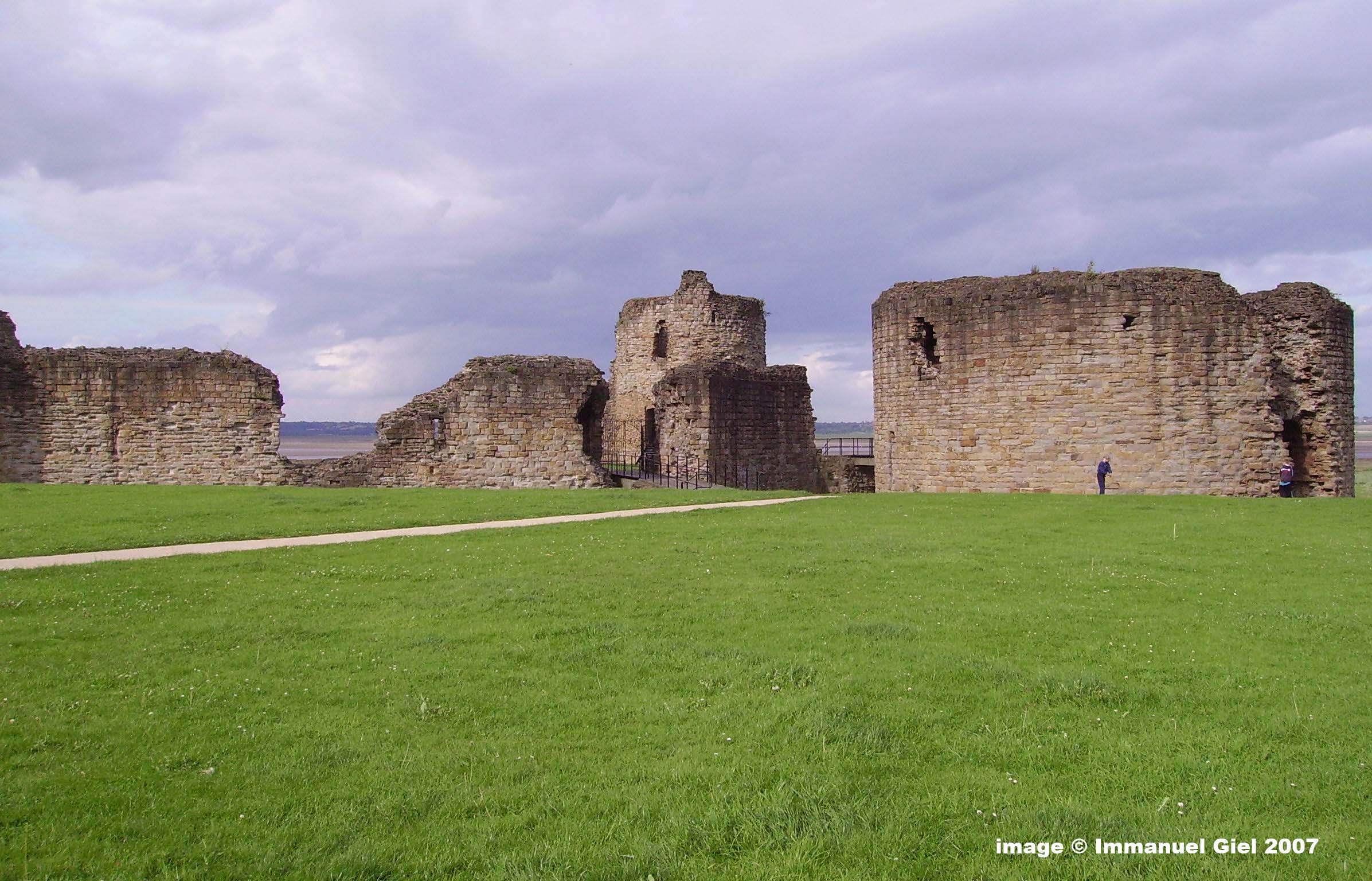 Flint was home to the first castle built in Wales by Edward I to subdue the Welsh. The castle appears in Shakespeare's Richard II, although the historical accuracy of the story is in doubt. Nowadays the castle is a ruin, surrounded by the railway and modern buildings.
Prestatyn has three beaches. Ffrith beach, behind sand dunes is home to an amusement park. The Central Beach has the Nova with an indoor swimming pool and entertainment facilities, whilst the eastern, Barkny Beach, is backed on by holiday camps. There are nature trails to the south of the town and the town forms the northern end of Offa's Dyke path which ends at Chepstow 170 miles to the south.
Many once grand seaside resorts are now a shadow of their former selves and none exemplifies the decline more than Rhyl. In its favour it has three miles of sandy beaches but many of its former attractions are long gone or derelict and what little remains seems seedy and down at heel. It's a few miles from the A55 trunk road and, frankly, it isn't worth detouring even to look at.
Colwyn Bay is home to three miles of sand and the beach area is cut off from the main town by both the main railway line and the A55 - that may be an advantage or disadvantage depending on your point of view - I would call it an advantage personally. The safe waters are popular for watersports from sailing to jet-skiing. There is a reasonably size amusement park, including an indoor swimming pool for days when the weather is not clement. The town has a zoo. If you are not feeling energetic a miniature railway runs along the promenade.
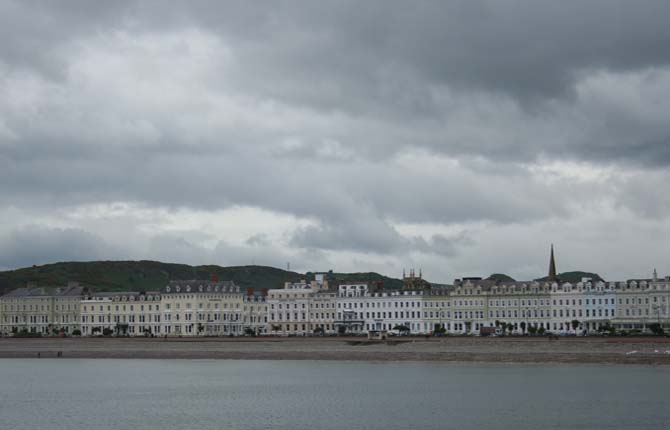 Llandudno is easily one of the best resorts in Wales, arguably in the entire country, especially if you aren't a fan of the "kiss me quick" tacky seaside resort. Another of the resorts developed as part of the railway revolution, Llandudno was fortunate in that its development was well planned rather than being allowed to sprawl. As a resort the town features wide boulevards and expansive promenades. Set below the impressive Great Ormes Head the town has two beaches, both sand and shingle. West Shore has a very low tide, stretching out a very long way and visitors should not venture out to far as it is easy to get cut off when the tide turns, the beach is south facing so is popular on sunny days. North Shore is a two mile stretch bounded by a promenade with a pier at the western end and Little Ormes Head at the eastern end. Street cafés give the town an almost Mediterranean feel and traditional attractions like donkey rides and Punch and Judy shows can still be found on the beach.
Great Ormes Head itself towers 679ft (207m) above the sea. At the summit there is a country park offering stunning views of Snowdonia to the south and on a clear day the Cumbrian mountains can be seen in the north. There is a path for the energetic to walk to the top from Llandudno but for the less mobile there is a toll road for drivers, a cable car or Britain's last surviving cable hauled tramway.
Conwy is an impressive town and the best-preserved medieval, fortified town in the country with most of the town walls and castle still intact. Built across the River Conwy, three bridges link the two sides of the town. There is a Thomas Telford suspension bridge, now pedestrian only, offering awesome sights of the towering castle. There is Robert Stephenson's railway bridge and a modern road bridge. A fair amount of the ramparts can be walked round, offering good views of the town. Needless to say there are numerous very old buildings in the town. Conwy is home to, reputedly, the smallest house in Britain, standing 8' 4" (2.5m) high and 6ft (1.8m) wide which overlooks the Quay, from where pleasure boat and fishing trips depart.
Bangor is a fairly nondescript resort but is redeemed by its history and it can trace its Christian roots to 81 years before the founding of Canterbury. Near the cathedral is the Bible Garden which was created to show all the plants mentioned in the Bible and every plant mentioned which can survive the local climate is indeed to be found here. The Museum Of Welsh Antiquities tells the story of the area from prehistoric to modern times.
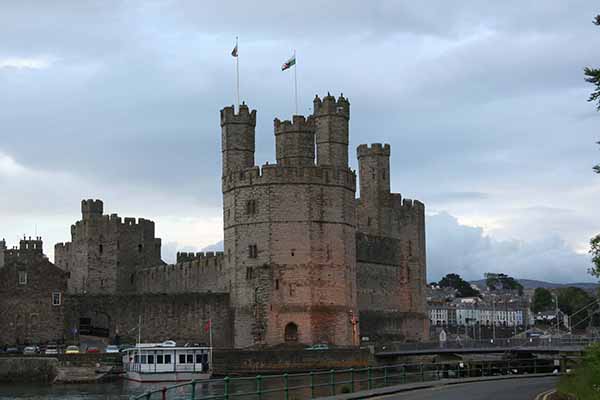 Following the progress of Edward's castles we come to Caernarfon home of the largest, much of which remains and the castle has been home to the investiture of the last two Princes Of Wales. In 1955 Caernarfon was in the running to be the capital city of Wales but was heavily defeated by Cardiff. The oldest part of the town, a maze of narrow streets, is still enclosed within the old city walls. Beneath the castle is the town quay, from where boat trips depart during the summer months.
Nefyn has a firm sandy beach, with shingle and rock pools at low tide. Boat trips operate for fishermen and tourists and when the wind is in the right direction a decent surf is available.
A winding twisty road leads from Penllech Bach to Pen-y-Craig, going through a valley and wooded ravine. From the bottom of the hill a five minute walk along the stream will bring you to a secluded, sandy beach.
Mynydd Mawr is on the southwestern tip of the Lleyn Peninsular and is reached by a winding road. Parking in the bottom of the two car parks will offer you a path to a tiny cove, a second path leads to the top of the 524ft (160m) tall cliffs.
Aberdaron is an unspoiled fishing village with whitewashed cottages. The church was a long way from the sea when built 1,400 years ago now it has its own sea wall to protect it. The sheltered beach is a popular base for surfers and divers.
Just down the road from Aberdaron is Porth Ysgo where the beach is reached via a delightful path through a valley of gorse, ferns and foxgloves following a stream which cascades to the sea in a series of small waterfalls. The beach is covered at high tide but as the water recedes dark rocks from a former magnesium mine are exposed.
Pwllheli is the main town on the Lleyn and is a popular resort with a sand / shingle beach to the south and a four mile long sandy beach to the north. The inner harbour is now a marina whilst some fishing boats still operate from the outer harbour.
The town of Criccieth is dominated by the ruins of its castle, which dates back to 13th century. The remains are home to a museum telling the story of Welsh castles.
Porthmadog is probably best known for being one end of the famous Ffestiniog Railway, which offers a 13 mile scenic trip through the mountains. Originally built to transport slate from Blaenau Ffestiniog to the port, nowadays the line transports tourists. Porthmadog now relies on tourism and is a centre for rock climbing, hill walking and fishing.
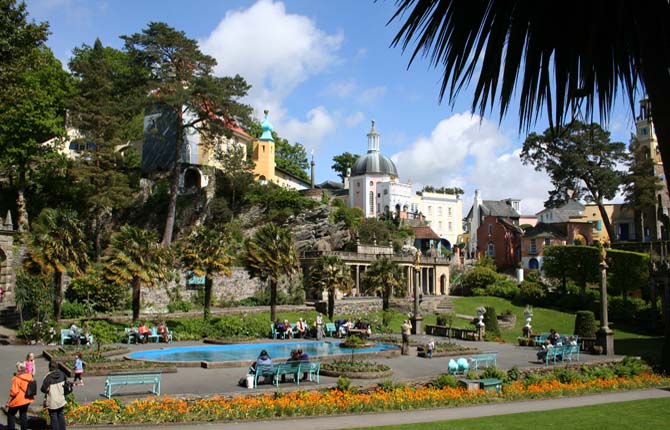 Anyone familiar with the cult TV series The Prisoner will instantly recognise Portmeirion as that is where the series was filmed although, thankfully, there are no huge balls rolling along the beach. Inspired by the Italian village of Portofino the eccentric Clough Williams-Ellis created an Italian styled village with one or two other styles thrown in for good measure. 50 buildings are arranged around a town square and the town is a holiday resort where visitors can stay in some of the villas. The village sits on a hillside and there are walks through subtropical gardens and a wide sandy beach, although swimming is not advised due to strong currents.
Harlech is a small town with a big castle. Another of Edward I's defences the, externally, intact castle towers over the town and surrounding countryside. The castle has seen many battles the most dramatic being when the Lancastrians withstood a seven year siege from the Yorkists before finally capitulating in the Wars of the Roses, inspiring the song Men Of Harlech.
Barmouth is a delightful resort replete with donkey rides, amusement arcades and sandy beaches but there is more to the town than the seaside as Barmouth is also a centre for the arts. It hosts a large arts exhibition each August and September sees a major arts festival. The resort is popular with windsurfers and surfers and the town is a good base for walkers.
Tywyn is home to the Talyllyn Railway, a narrow gauge railway running through seven miles of spectacular mountain scenery. It was the first line in Britain to be run by a railway preservation society. Tywyn is Welsh for sand dune - quite appropriate as there the four miles of coastline here are backed by dunes.
Aberdovey (Aberdyfi) with its miles of sandy beaches is a popular centre for sailing and watersports.
Borth is popular with bathers and surfers with the beach set in front of a sea wall. Animalarium is a small zoo located in the south of the town. A five-mile cliff top walk is available south of the town heading towards Aberystwyth, from where you can catch a train back to Borth.
Aberystwyth is the main resort in west Wales but the sea front suffered considerable damage in the winter storms of 2013-14. Constitution Hill overlooks the town and offers spectacular views, the top can be reached by either a stiff climb or Britain's longest electric powered cliff railway. The old harbour offers fishing and pleasure trips. The Ceredigion Museum offers an eclectic mix of local history and domestic items, including a reconstruction of a traditional cottage. A narrow gauge railway runs from alongside the main railway station, covering a 12 mile route. The town is home to the National Library Of Wales, which has various exhibitions and the town is also the main campus of the University Of Wales.
Aberarth is a tight, compactly laid out town, once a fishing port but now home to a shingle beach. Nearby is the Derwen Welsh Cob Centre, telling the story of the famous breed of horse.
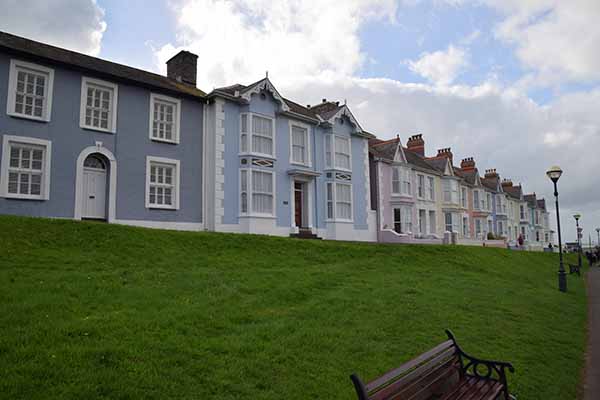 Aberaeron sees pastel shaded houses giving the town a Mediterranean feel. The small harbour is home to pleasure and fishing boats with some shingle beaches nearby. Clôs Pencarreg is home to a major craft centre.
New Quay fulfills many peoples idea of a typical fishing town with narrow, twisting streets leading to a small harbour. Being in a sheltered position it was, once, the busiest port on this section of the coastline. A few fishing boats remain but the harbour is now home to pleasure craft, some of which provide dolphin spotting trips. Mackerel and Pollock can be caught from the harbour walls. The poet Dylan Thomas lived in the town for some of his life. A nearby Bird Hospital treats injured and oiled birds and seals.
Aberporth was a major herring port, it's been reported nine million of the fish were caught one night in 1808. Today it is a resort with two sandy beaches. Nearby is the Felinwynt Rainforest Centre, home to many exotic butterflies.
Cardigan gives its name to the bay after which this stretch of coastline is named. It was once a busy port but silting put paid to that and with the coming of the railway the town became a tourist centre.
Fishguard is a town on two levels with part of the town set on a hill and the remainder set around the harbour. The Royal Oak pub on the top of the town is where the French surrendered in 1797 and the pub contains battle memorabilia. Fishguard is best know for its ferry service to Ireland.
Strumble Head is a headland with spectacular views and on a clear it is possible to see the Irish coast, a small island just off the head is home to the Strumble Lighthouse.
St David's is no bigger than many small towns in the UK but it is holds the honour of being Britain's smallest city. The cathedral, dating back to the 11th century, was founded by St David, patron saint of Wales. It certainly doesn't have a city feel but is very much like a tight knit town where everyone seems to know everyone else.
Solva set in a narrow inlet used to be a major port, it even had a regular trans-Atlantic service. Due to it's location it was also home to pirates and smugglers.
St Brides Haven provides a relaxing contrast to the nearby rugged coastline. A remote sandy coves with rock pools to explore and a magnet for sea anglers.
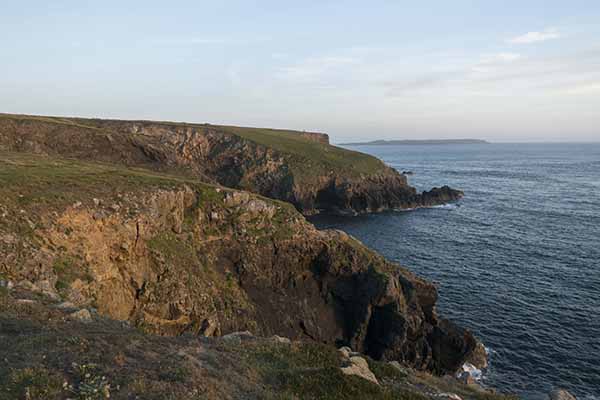 It is a ten minute walk from Marloes village to Marloes Sands but a walk well worth it, as many describe the sands as the best in Wales. Home to golden sands and dramatic cliffs. Indeed the cliffs are a great place to watch the sunset over Skomer. Skomer is a nature reserve which becomes very popular in the summer as it attracts around 6,000 pairs of puffins, the largest colony in southern Britain.
St Ann's Head is home to a lighthouse and coastguard station and the headland offers views of ships of all shapes and sizes entering Milford Haven
Lord Nelson once described Milford Haven as the best natural harbour in the Northern Hemisphere. It is a town which has reinvented itself over the years. Built as a whaling centre and naval dockyard the town declined until the 1880's when the port was rebuilt to become a major fishing centre. The town adapted again in the 1960's to become a major oil refinery but that industry declined towards the end of the 1980's. The docks have been renovated with many visitor attractions and the beaches are home to traditional seaside attractions. It has to be said the town is surprisingly attractive, so if you have preconceptions of a dreary industrial backwater, which has seen better days, then think again.
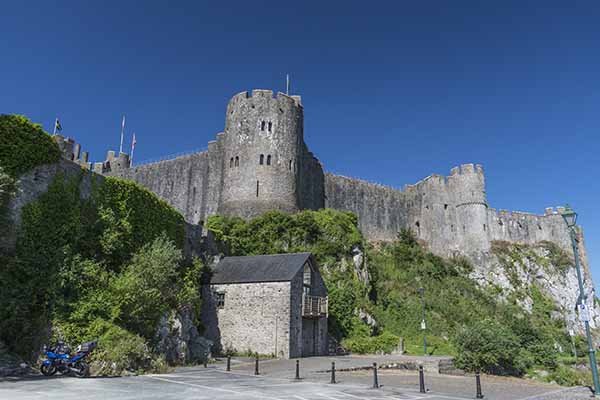 In 1840 the Admiralty established a dockyard at Pembroke Dock built in response to the high costs at nearby Milford Haven, the surrounding town was built to house the workers and shipbuilding continued in the town until 1926. In the Second World War the port was a base for flying boats and the Atlantic convoys. The port is still used by military and commercial traffic as well as a ferry link to Ireland. The town of Pembroke is dominated by its castle with a main street having a mish-mash of architectural styles. The castle has only fallen once during its history and that was during the Civil War when Cromwell's army overran it.
Two giant limestone pillars emerge from the sea at Elegug Stacks. In the breeding season the stacks are covered by seabirds, most notably, guillemots. Nearby is a natural stone arch, known as the Green Bridge Of Wales.
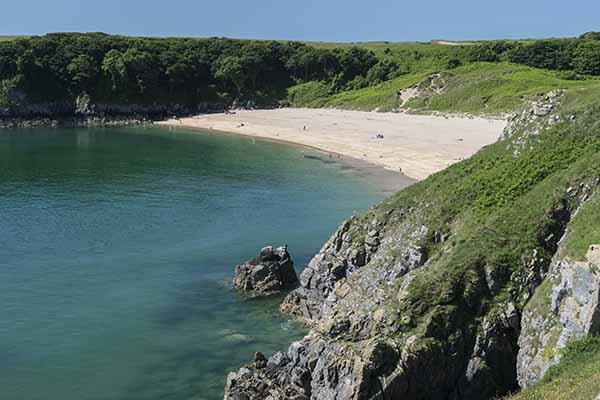 Stackpole Quay is now disused offering a secluded spot where fossils abound. At Stackpole Head the sea has carved arches and on one side the cave roofs have collapsed offering spectacular blow holes at some high tides. The nearby Stackpole Estate is owned by the National Trust, offering gardens and a nature reserve with 18 miles (30km) of interconnected walks. A 20 minute trek, and I mean trek, from the Stackpole Quay car park will take you to the delightfully named , a secluded bay with crystal clear waters.
The walk from Stackpole Quay to Barafundle Bay follows part of the Pembrokeshire Coastal Path, which to be one of the most beautiful walks in the UK.
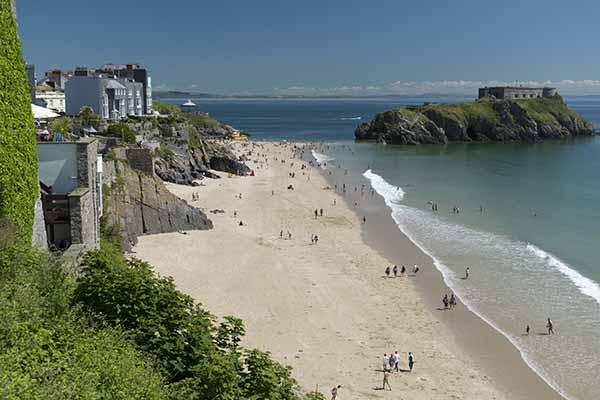 Tenby, arguably, has one of the most beautiful harbours in the country. Add in some beautiful beaches and it's easy to see why Tenby is such a popular resort. Dating back to Norman times the town was heavily developed in the 19th century, although many 13th century buildings survive in the old part of the town. Beautiful pastel coloured buildings overlook the harbour, giving the town a Mediterranean feel. A free folk festival takes place the late May Bank Holiday weekend, whilst a 9 day fish festival takes place along most of the Pembrokeshire coastline late June / early July. However it is a very popular resort and on hot sunny days parking is nigh on impossible, unless arriving early.
Pendine Sands is a six mile stretch of compact sand and was home to several land speed record attempts in the 1920's.
Pembrey is a massive area of dunes, woodland and sandy beaches. For many years the area was "out of bounds" as it was home to a large ordnance factory. The factory closed in the 1960's and the area is now the Pembrey Country Park with walks, a miniature railway, equestrian centre and dry ski slope, not forgetting seven miles of sandy beaches.
Llanelli, once home of the tinplate industry, is one of those towns which has seen better days but now has little going for it apart from a reasonably good Rugby Union team. The one redeeming feature, if you're into that sort of thing, is the towns market is very popular.
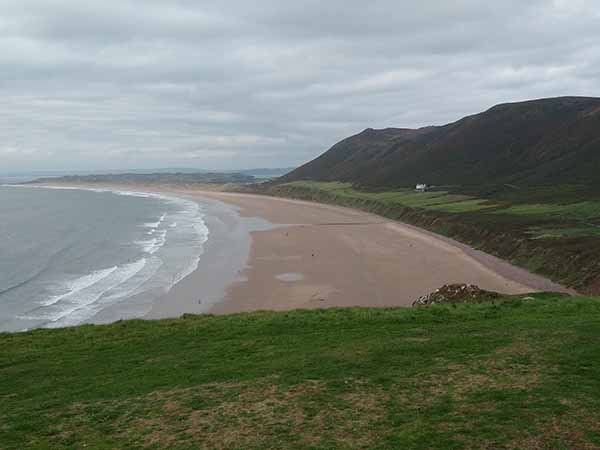 The Gower Peninsular is, without doubt, the jewel in the South Wales coastal crown, it's an area where you could easily stay a week and still not see it all. The downside is the delights are not a secret and the area is very popular and, occasionally, overcrowded.
Swansea has continually reinvented itself, starting life as a fishing village, becoming a major industrial centre and now a major tourist centre. The once busy docks, once the lifeblood of the city, has been redeveloped as a Maritime Quarter, with the National Waterfront Museum as its centrepiece. Ty Lly, the Dylan Thomas Centre, is at the cultural heart of the city. Swansea is also a coastal resort with sandy beaches. Plantasia is a large glass pyramid housing more than 5,000 plants.
Porthcawl was a major port for exporting coal until the expansion of Barry and Port Talbot killed the trade. The town then developed as a tourist attraction. Unbelievably the inner harbour was filled in to become a car park, whilst the outer harbour is a base for pleasure craft. Coney Beach Pleasure Park opened in 1920 and was the main attraction in the town, reaching it's heyday in the 1950's to the 1980's, since when it has been in steady decline. There was a minor revival in the early 2000's but visitor numbers are again declining and it is a moot point as to whether it will be around to celebrate its centenary. Even without the pleasure park the beaches are good and for beach lovers the town is a good place to visit.
The town of Ogmore is atop some cliffs with a path leading to a sandy beach, where safe bathing areas are clearly marked out.
Barry is a town of contrasts, on the one hand a busy port on the other a seaside resort with gaudy amusement arcades and a holiday camp. Three beaches are to be found there.
Penarth is the complete contrast to Barry and is a much quieter, more refined, resort with a long promenade and lovely gardens. the shingle beach isn't that comfortable. The town is home to a delightful pier from where pleasure cruises depart in the summer months.
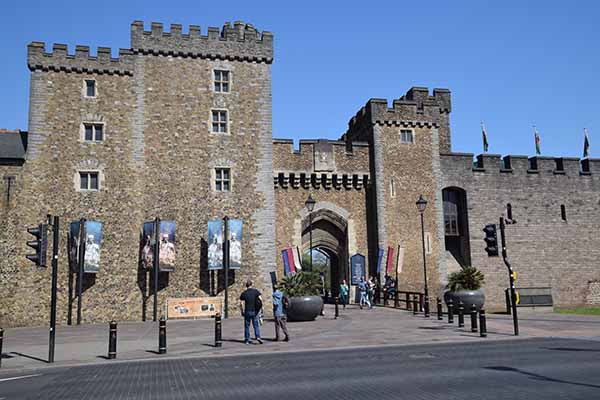 The capital of Wales and a major international city in its own right, Cardiff has seen massive investment in its infrastructure in the last twenty five years and from being a major port serving the industrial heartland of South Wales it has built on its heritage to become a major tourist attraction.
Newport is only a few miles from Cardiff but has its own identity. Like its neighbour its role has changed as industry has diminished and some of the docks have been redeveloped into an area for leisure and the arts. A flight of 14 locks on the Monmouthshire Canal can be found north of the city and the restored Transporter Bridge is worth a view. Just outside the town, towards Cardiff, is Tredegar Park a green oasis. The remains of Newport Castle have an exhibition telling the story of the Chartist uprising.
Caerleon, a few miles north of Newport has some splendid Roman remains. It was a major Roman town, as important as Chester. Unlike Chester development has not destroyed the Roman legacy and the remains are worth visiting.
Our tour of the Welsh coast has been dominated by castles and Chepstow is a fitting end as it is overlooked by its dramatic Norman castle. The town itself still has twisting, narrow mediaeval streets and it makes a great base for touring the dramatic Wye Valley. A few miles up the river are the remains of Tintern Abbey, well worth a detour.
Previous: Silloth - Hoylake Next: Bristol - Portchester
Flint was home to the first castle built in Wales by Edward I to subdue the Welsh. The castle appears in Shakespeare's Richard II, although the historical accuracy of the story is in doubt. Nowadays the castle is a ruin, surrounded by the railway and modern buildings. Prestatyn has three beaches. Ffrith beach, behind sand dunes is home to an amusement park. The Central Beach has the Nova with an indoor swimming pool and entertainment facilities, whilst the eastern, Barkny Beach, is backed on by holiday camps. There are nature trails to the south of the town and the town forms the northern end of Offa's Dyke path which ends at Chepstow 170 miles to the south.
Many once grand seaside resorts are now a shadow of their former selves and none exemplifies the decline more than Rhyl. In its favour it has three miles of sandy beaches but many of its former attractions are long gone or derelict and what little remains seems seedy and down at heel. It's a few miles from the A55 trunk road and, frankly, it isn't worth detouring even to look at.
Colwyn Bay is home to three miles of sand and the beach area is cut off from the main town by both the main railway line and the A55 - that may be an advantage or disadvantage depending on your point of view - I would call it an advantage personally. The safe waters are popular for watersports from sailing to jet-skiing. There is a reasonably size amusement park, including an indoor swimming pool for days when the weather is not clement. The town has a zoo. If you are not feeling energetic a miniature railway runs along the promenade.
Llandudno is easily one of the best resorts in Wales, arguably in the entire country, especially if you aren't a fan of the "kiss me quick" tacky seaside resort. Another of the resorts developed as part of the railway revolution, Llandudno was fortunate in that its development was well planned rather than being allowed to sprawl. As a resort the town features wide boulevards and expansive promenades. Set below the impressive Great Ormes Head the town has two beaches, both sand and shingle. West Shore has a very low tide, stretching out a very long way and visitors should not venture out to far as it is easy to get cut off when the tide turns, the beach is south facing so is popular on sunny days. North Shore is a two mile stretch bounded by a promenade with a pier at the western end and Little Ormes Head at the eastern end. Street cafés give the town an almost Mediterranean feel and traditional attractions like donkey rides and Punch and Judy shows can still be found on the beach.Great Ormes Head itself towers 679ft (207m) above the sea. At the summit there is a country park offering stunning views of Snowdonia to the south and on a clear day the Cumbrian mountains can be seen in the north. There is a path for the energetic to walk to the top from Llandudno but for the less mobile there is a toll road for drivers, a cable car or Britain's last surviving cable hauled tramway.
Conwy is an impressive town and the best-preserved medieval, fortified town in the country with most of the town walls and castle still intact. Built across the River Conwy, three bridges link the two sides of the town. There is a Thomas Telford suspension bridge, now pedestrian only, offering awesome sights of the towering castle. There is Robert Stephenson's railway bridge and a modern road bridge. A fair amount of the ramparts can be walked round, offering good views of the town. Needless to say there are numerous very old buildings in the town. Conwy is home to, reputedly, the smallest house in Britain, standing 8' 4" (2.5m) high and 6ft (1.8m) wide which overlooks the Quay, from where pleasure boat and fishing trips depart.
Bangor is a fairly nondescript resort but is redeemed by its history and it can trace its Christian roots to 81 years before the founding of Canterbury. Near the cathedral is the Bible Garden which was created to show all the plants mentioned in the Bible and every plant mentioned which can survive the local climate is indeed to be found here. The Museum Of Welsh Antiquities tells the story of the area from prehistoric to modern times.
Following the progress of Edward's castles we come to Caernarfon home of the largest, much of which remains and the castle has been home to the investiture of the last two Princes Of Wales. In 1955 Caernarfon was in the running to be the capital city of Wales but was heavily defeated by Cardiff. The oldest part of the town, a maze of narrow streets, is still enclosed within the old city walls. Beneath the castle is the town quay, from where boat trips depart during the summer months.Nefyn has a firm sandy beach, with shingle and rock pools at low tide. Boat trips operate for fishermen and tourists and when the wind is in the right direction a decent surf is available.
A winding twisty road leads from Penllech Bach to Pen-y-Craig, going through a valley and wooded ravine. From the bottom of the hill a five minute walk along the stream will bring you to a secluded, sandy beach.
Mynydd Mawr is on the southwestern tip of the Lleyn Peninsular and is reached by a winding road. Parking in the bottom of the two car parks will offer you a path to a tiny cove, a second path leads to the top of the 524ft (160m) tall cliffs.
Aberdaron is an unspoiled fishing village with whitewashed cottages. The church was a long way from the sea when built 1,400 years ago now it has its own sea wall to protect it. The sheltered beach is a popular base for surfers and divers.
Just down the road from Aberdaron is Porth Ysgo where the beach is reached via a delightful path through a valley of gorse, ferns and foxgloves following a stream which cascades to the sea in a series of small waterfalls. The beach is covered at high tide but as the water recedes dark rocks from a former magnesium mine are exposed.
Pwllheli is the main town on the Lleyn and is a popular resort with a sand / shingle beach to the south and a four mile long sandy beach to the north. The inner harbour is now a marina whilst some fishing boats still operate from the outer harbour.
The town of Criccieth is dominated by the ruins of its castle, which dates back to 13th century. The remains are home to a museum telling the story of Welsh castles.
Porthmadog is probably best known for being one end of the famous Ffestiniog Railway, which offers a 13 mile scenic trip through the mountains. Originally built to transport slate from Blaenau Ffestiniog to the port, nowadays the line transports tourists. Porthmadog now relies on tourism and is a centre for rock climbing, hill walking and fishing.
Anyone familiar with the cult TV series The Prisoner will instantly recognise Portmeirion as that is where the series was filmed although, thankfully, there are no huge balls rolling along the beach. Inspired by the Italian village of Portofino the eccentric Clough Williams-Ellis created an Italian styled village with one or two other styles thrown in for good measure. 50 buildings are arranged around a town square and the town is a holiday resort where visitors can stay in some of the villas. The village sits on a hillside and there are walks through subtropical gardens and a wide sandy beach, although swimming is not advised due to strong currents.Harlech is a small town with a big castle. Another of Edward I's defences the, externally, intact castle towers over the town and surrounding countryside. The castle has seen many battles the most dramatic being when the Lancastrians withstood a seven year siege from the Yorkists before finally capitulating in the Wars of the Roses, inspiring the song Men Of Harlech.
Barmouth is a delightful resort replete with donkey rides, amusement arcades and sandy beaches but there is more to the town than the seaside as Barmouth is also a centre for the arts. It hosts a large arts exhibition each August and September sees a major arts festival. The resort is popular with windsurfers and surfers and the town is a good base for walkers.
Tywyn is home to the Talyllyn Railway, a narrow gauge railway running through seven miles of spectacular mountain scenery. It was the first line in Britain to be run by a railway preservation society. Tywyn is Welsh for sand dune - quite appropriate as there the four miles of coastline here are backed by dunes.
Aberdovey (Aberdyfi) with its miles of sandy beaches is a popular centre for sailing and watersports.
Borth is popular with bathers and surfers with the beach set in front of a sea wall. Animalarium is a small zoo located in the south of the town. A five-mile cliff top walk is available south of the town heading towards Aberystwyth, from where you can catch a train back to Borth.
Aberystwyth is the main resort in west Wales but the sea front suffered considerable damage in the winter storms of 2013-14. Constitution Hill overlooks the town and offers spectacular views, the top can be reached by either a stiff climb or Britain's longest electric powered cliff railway. The old harbour offers fishing and pleasure trips. The Ceredigion Museum offers an eclectic mix of local history and domestic items, including a reconstruction of a traditional cottage. A narrow gauge railway runs from alongside the main railway station, covering a 12 mile route. The town is home to the National Library Of Wales, which has various exhibitions and the town is also the main campus of the University Of Wales.
Aberarth is a tight, compactly laid out town, once a fishing port but now home to a shingle beach. Nearby is the Derwen Welsh Cob Centre, telling the story of the famous breed of horse.
Aberaeron sees pastel shaded houses giving the town a Mediterranean feel. The small harbour is home to pleasure and fishing boats with some shingle beaches nearby. Clôs Pencarreg is home to a major craft centre.New Quay fulfills many peoples idea of a typical fishing town with narrow, twisting streets leading to a small harbour. Being in a sheltered position it was, once, the busiest port on this section of the coastline. A few fishing boats remain but the harbour is now home to pleasure craft, some of which provide dolphin spotting trips. Mackerel and Pollock can be caught from the harbour walls. The poet Dylan Thomas lived in the town for some of his life. A nearby Bird Hospital treats injured and oiled birds and seals.
Aberporth was a major herring port, it's been reported nine million of the fish were caught one night in 1808. Today it is a resort with two sandy beaches. Nearby is the Felinwynt Rainforest Centre, home to many exotic butterflies.
Cardigan gives its name to the bay after which this stretch of coastline is named. It was once a busy port but silting put paid to that and with the coming of the railway the town became a tourist centre.
Fishguard is a town on two levels with part of the town set on a hill and the remainder set around the harbour. The Royal Oak pub on the top of the town is where the French surrendered in 1797 and the pub contains battle memorabilia. Fishguard is best know for its ferry service to Ireland.
Strumble Head is a headland with spectacular views and on a clear it is possible to see the Irish coast, a small island just off the head is home to the Strumble Lighthouse.
St David's is no bigger than many small towns in the UK but it is holds the honour of being Britain's smallest city. The cathedral, dating back to the 11th century, was founded by St David, patron saint of Wales. It certainly doesn't have a city feel but is very much like a tight knit town where everyone seems to know everyone else.
Solva set in a narrow inlet used to be a major port, it even had a regular trans-Atlantic service. Due to it's location it was also home to pirates and smugglers.
St Brides Haven provides a relaxing contrast to the nearby rugged coastline. A remote sandy coves with rock pools to explore and a magnet for sea anglers.
It is a ten minute walk from Marloes village to Marloes Sands but a walk well worth it, as many describe the sands as the best in Wales. Home to golden sands and dramatic cliffs. Indeed the cliffs are a great place to watch the sunset over Skomer. Skomer is a nature reserve which becomes very popular in the summer as it attracts around 6,000 pairs of puffins, the largest colony in southern Britain.St Ann's Head is home to a lighthouse and coastguard station and the headland offers views of ships of all shapes and sizes entering Milford Haven
Lord Nelson once described Milford Haven as the best natural harbour in the Northern Hemisphere. It is a town which has reinvented itself over the years. Built as a whaling centre and naval dockyard the town declined until the 1880's when the port was rebuilt to become a major fishing centre. The town adapted again in the 1960's to become a major oil refinery but that industry declined towards the end of the 1980's. The docks have been renovated with many visitor attractions and the beaches are home to traditional seaside attractions. It has to be said the town is surprisingly attractive, so if you have preconceptions of a dreary industrial backwater, which has seen better days, then think again.
In 1840 the Admiralty established a dockyard at Pembroke Dock built in response to the high costs at nearby Milford Haven, the surrounding town was built to house the workers and shipbuilding continued in the town until 1926. In the Second World War the port was a base for flying boats and the Atlantic convoys. The port is still used by military and commercial traffic as well as a ferry link to Ireland. The town of Pembroke is dominated by its castle with a main street having a mish-mash of architectural styles. The castle has only fallen once during its history and that was during the Civil War when Cromwell's army overran it. Two giant limestone pillars emerge from the sea at Elegug Stacks. In the breeding season the stacks are covered by seabirds, most notably, guillemots. Nearby is a natural stone arch, known as the Green Bridge Of Wales.
Stackpole Quay is now disused offering a secluded spot where fossils abound. At Stackpole Head the sea has carved arches and on one side the cave roofs have collapsed offering spectacular blow holes at some high tides. The nearby Stackpole Estate is owned by the National Trust, offering gardens and a nature reserve with 18 miles (30km) of interconnected walks. A 20 minute trek, and I mean trek, from the Stackpole Quay car park will take you to the delightfully named , a secluded bay with crystal clear waters.The walk from Stackpole Quay to Barafundle Bay follows part of the Pembrokeshire Coastal Path, which to be one of the most beautiful walks in the UK.
Tenby, arguably, has one of the most beautiful harbours in the country. Add in some beautiful beaches and it's easy to see why Tenby is such a popular resort. Dating back to Norman times the town was heavily developed in the 19th century, although many 13th century buildings survive in the old part of the town. Beautiful pastel coloured buildings overlook the harbour, giving the town a Mediterranean feel. A free folk festival takes place the late May Bank Holiday weekend, whilst a 9 day fish festival takes place along most of the Pembrokeshire coastline late June / early July. However it is a very popular resort and on hot sunny days parking is nigh on impossible, unless arriving early.Pendine Sands is a six mile stretch of compact sand and was home to several land speed record attempts in the 1920's.
Pembrey is a massive area of dunes, woodland and sandy beaches. For many years the area was "out of bounds" as it was home to a large ordnance factory. The factory closed in the 1960's and the area is now the Pembrey Country Park with walks, a miniature railway, equestrian centre and dry ski slope, not forgetting seven miles of sandy beaches.
Llanelli, once home of the tinplate industry, is one of those towns which has seen better days but now has little going for it apart from a reasonably good Rugby Union team. The one redeeming feature, if you're into that sort of thing, is the towns market is very popular.
The Gower Peninsular is, without doubt, the jewel in the South Wales coastal crown, it's an area where you could easily stay a week and still not see it all. The downside is the delights are not a secret and the area is very popular and, occasionally, overcrowded.Swansea has continually reinvented itself, starting life as a fishing village, becoming a major industrial centre and now a major tourist centre. The once busy docks, once the lifeblood of the city, has been redeveloped as a Maritime Quarter, with the National Waterfront Museum as its centrepiece. Ty Lly, the Dylan Thomas Centre, is at the cultural heart of the city. Swansea is also a coastal resort with sandy beaches. Plantasia is a large glass pyramid housing more than 5,000 plants.
Porthcawl was a major port for exporting coal until the expansion of Barry and Port Talbot killed the trade. The town then developed as a tourist attraction. Unbelievably the inner harbour was filled in to become a car park, whilst the outer harbour is a base for pleasure craft. Coney Beach Pleasure Park opened in 1920 and was the main attraction in the town, reaching it's heyday in the 1950's to the 1980's, since when it has been in steady decline. There was a minor revival in the early 2000's but visitor numbers are again declining and it is a moot point as to whether it will be around to celebrate its centenary. Even without the pleasure park the beaches are good and for beach lovers the town is a good place to visit.
The town of Ogmore is atop some cliffs with a path leading to a sandy beach, where safe bathing areas are clearly marked out.
Barry is a town of contrasts, on the one hand a busy port on the other a seaside resort with gaudy amusement arcades and a holiday camp. Three beaches are to be found there.
Penarth is the complete contrast to Barry and is a much quieter, more refined, resort with a long promenade and lovely gardens. the shingle beach isn't that comfortable. The town is home to a delightful pier from where pleasure cruises depart in the summer months.
The capital of Wales and a major international city in its own right, Cardiff has seen massive investment in its infrastructure in the last twenty five years and from being a major port serving the industrial heartland of South Wales it has built on its heritage to become a major tourist attraction.Newport is only a few miles from Cardiff but has its own identity. Like its neighbour its role has changed as industry has diminished and some of the docks have been redeveloped into an area for leisure and the arts. A flight of 14 locks on the Monmouthshire Canal can be found north of the city and the restored Transporter Bridge is worth a view. Just outside the town, towards Cardiff, is Tredegar Park a green oasis. The remains of Newport Castle have an exhibition telling the story of the Chartist uprising.
Caerleon, a few miles north of Newport has some splendid Roman remains. It was a major Roman town, as important as Chester. Unlike Chester development has not destroyed the Roman legacy and the remains are worth visiting.
Our tour of the Welsh coast has been dominated by castles and Chepstow is a fitting end as it is overlooked by its dramatic Norman castle. The town itself still has twisting, narrow mediaeval streets and it makes a great base for touring the dramatic Wye Valley. A few miles up the river are the remains of Tintern Abbey, well worth a detour.
Previous: Silloth - Hoylake Next: Bristol - Portchester