
Blackheath
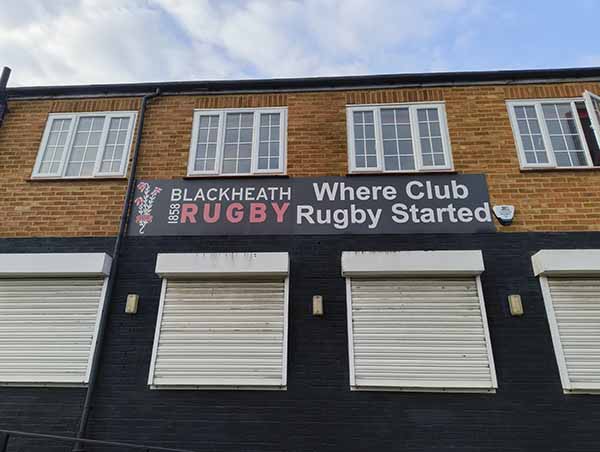 There are rugby clubs with a long history and then there is Blackheath. Founded in 1858, Blackheath Football Club is recognised as the oldest independent, open rugby club in the world. 'Open' means it wasn't restricted to members of a particular school, university or profession. That's quite some heritage and, for me, Blackheath is the epitome of the traditional rugby club.
Indeed, Blackheath played an important part in the development of rugby itself. The club was involved in the formation of the Rugby Football Union in 1871 and was instrumental in organising the first international rugby match between England and Scotland.
And there's another significant rugby connection. Percy Carpmael, a former Blackheath player, founded the Barbarians in 1890. The famous invitational club has subsequently become one of the most recognisable names in world rugby, so Blackheath's contribution to the game extends considerably beyond its own playing record.
The club's former home was the famous Rectory Field, where it played for well over 130 years before moving its first XV to Well Hall in Eltham in 2016. Although the move was a significant change for a club steeped in tradition, the new home provides a rather different setting for one of rugby's most historic institutions.
Getting There
Blackheath's present home, known as The Utilita, is in Kidbrooke Lane, Eltham, in south-east London.
Public transport is probably the easiest option, with Eltham railway station less than half a mile away and approximately a ten-minute walk from the ground. There are regular trains from central London, including London Bridge, Cannon Street and Charing Cross, making it reasonably straightforward to reach.
There are also several local bus routes serving the area.
For those travelling by car, there is an onsite car park with space for around 100 vehicles, although it operates on a first-come, first-served basis. Parking costs £5, and the club recommends arriving early as spaces can disappear fairly quickly.
Admission
Blackheath is not the cheapest of the traditional club grounds, with published non-member admission prices of £25 for standing and £30 for a seat in the stand. Under-18s are admitted free.
The additional £5 for a seat is something I would think twice about, as I'll explain shortly.
The Ground
Well Hall sits somewhere between the basic traditional rugby grounds and the rather more sophisticated neo-Premiership stadiums. It hasn't lost sight of its club rugby roots, but neither is it short of a few modern touches.
There is a proper rugby ground here, rather than a converted sports field with a couple of temporary structures thrown around it. It has a decent feel about it and manages to retain something of the traditional rugby club atmosphere.
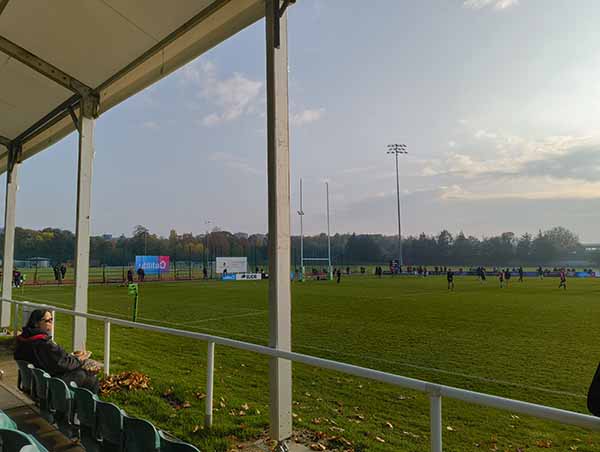 There are seated stands and terracing around much of the pitch, providing a choice of viewing positions.
Unfortunately, the stand comes with a couple of drawbacks. The supporting pillars create restricted views in certain positions, which is irritating enough, but its positioning also means that it faces directly into the afternoon sun.
On my visit, the combination of sunshine and obstructed views rather defeated the object of paying extra for a seat. I persevered until half-time before giving up and finding somewhere else to watch the second half.
I'm not entirely convinced that the £5 upgrade represents particularly good value. A stand should surely offer a better viewing experience than standing around the pitch, not introduce a couple of additional obstacles!
Facilities and Atmosphere
This is very much a traditional rugby club, and that's not necessarily a criticism. There is a sense that the emphasis remains on the rugby rather than trying to turn match day into some sort of entertainment extravaganza.
There are clubhouse and bar facilities, along with outside catering, so there's no need to go hungry or thirsty. The club also offers a pre-match sit-down lunch for those wanting to make more of their visit, although this needs to be booked in advance.
You won't find the scale of facilities associated with the Premiership's bigger grounds, but equally, you shouldn't expect them. Blackheath occupies a comfortable middle ground, offering a little more than the bare essentials without losing its club identity.
The atmosphere is what you would expect from a club with such a long history. There is a connection with the game that goes back generations, and it's worth remembering that Blackheath was playing rugby long before most of the clubs we visit today even existed, although the day I visited the Bedford away fans made more noise than the locals.
Overall Impression
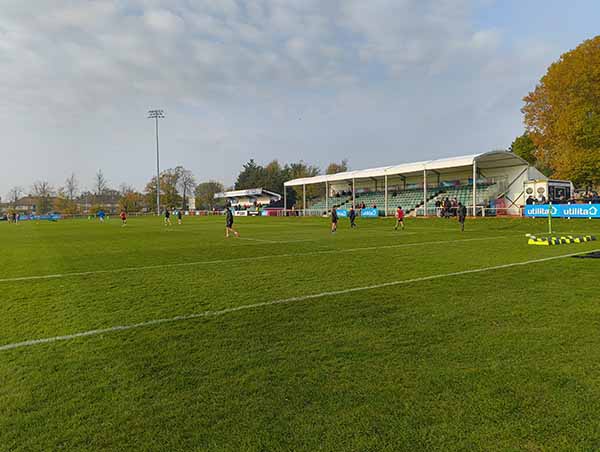 Blackheath is an enjoyable addition to the rugby ground collection, not least because of its remarkable place in the history of the sport.
The ground itself strikes a reasonable balance between traditional club rugby and modern facilities. It isn't going to compete with the grander stadiums, but it doesn't need to.
My main reservation is the stand. Charging an additional £5 for a seat with obstructed views and an afternoon sun problem seems a little optimistic. I certainly wouldn't bother paying the supplement again.
Nevertheless, this is a club that deserves respect. When you're watching rugby at Blackheath, you're watching at one of the places where the foundations of the modern game were laid. Its contribution to rugby history, including the creation of the Barbarians, makes it a rather special place to visit.
Return to England Rugby home page