
Gran Canaria
Gran Canaria is one of those destinations that has somehow managed to acquire two completely different personalities. Along the coast you have the familiar Canary Islands holiday scene: enormous hotels, British pubs, sunbeds, swimming pools and enough fish and chips to keep a small army happy. Head inland, however, and you discover dramatic mountains, deep valleys, attractive villages and scenery that can make you wonder whether you are actually on the same island.
The island is often described as a miniature continent, and that is not as ridiculous as it sounds. Despite being relatively small, Gran Canaria has an extraordinary variety of landscapes. The south is generally dry and sunny, the north is greener and more fertile, while the mountainous interior is a completely different world again.
 For many visitors, the starting point is Las Palmas de Gran Canaria, the island's capital and by far its largest city. It is a substantial city rather than simply a holiday resort, and consequently has considerably more character than some of the purpose-built tourist developments elsewhere on the island.
The Vegueta district is the historic heart of Las Palmas, with narrow cobbled streets, attractive old buildings and plenty of history. The magnificent Cathedral of Santa Ana dominates the district and is one of the city's principal landmarks. Nearby you will find the Casa de Colón, traditionally associated with Christopher Columbus, and a collection of museums and historic buildings.
Las Palmas also has a rather splendid urban beach. Las Canteras stretches for several kilometres and is one of the best city beaches in Spain. It has golden sand, a promenade and plenty of cafés, restaurants and shops. The reef offshore provides some protection from the Atlantic, making the beach particularly popular with swimmers.
For sheer holiday tourism, however, the action moves south.
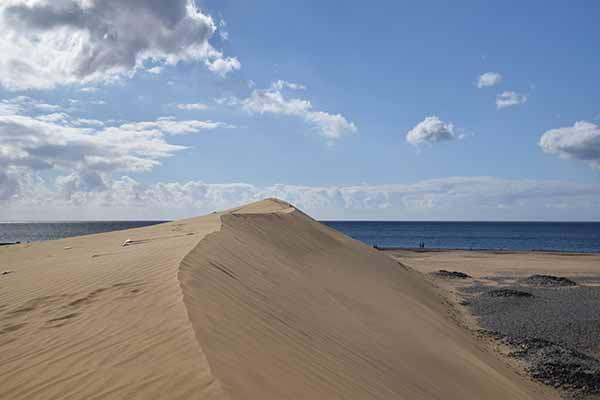 Maspalomas is probably the best-known resort on Gran Canaria and is famous for its enormous sand dunes. The Dunas de Maspalomas are genuinely impressive, with golden dunes stretching towards the sea. They provide one of the island's most distinctive landscapes and are considerably more interesting than simply spending the day beside a hotel swimming pool.
Next door is Playa del Inglés, which is almost the complete opposite of the old villages and mountain scenery. It is a huge purpose-built resort containing hotels, apartments, restaurants, bars, shopping centres and nightlife. If you want entertainment, you will find it. If you want peace and quiet, you may want to look elsewhere.
The coastline continues through a succession of resorts, including Puerto Rico, Amadores, Arguineguín and Puerto de Mogán. Each has its own character, although the development can sometimes seem almost continuous.
 Puerto de Mogán is often described as "Little Venice", which is perhaps laying it on a bit thick, but it is undoubtedly attractive. Canals, little bridges, colourful buildings and a pleasant marina give it considerably more charm than some of the larger resorts. The harbour is particularly enjoyable for a stroll, although the place becomes extremely busy when the coach tours arrive.
Arguineguín is rather more interesting if you want to see something resembling a genuine Canarian community. It still has a working harbour and fishing heritage alongside the tourist facilities. It is also a popular destination for Scandinavian visitors, giving it a slightly different atmosphere from the more British-oriented resorts.
But the real surprise of Gran Canaria is what happens when you leave the coast.
The interior is spectacular. Roads wind upwards through mountains and valleys, with viewpoints appearing around almost every bend. The landscape can change dramatically within a relatively short distance, from barren volcanic scenery to pine forests and fertile valleys.
One of the island's most famous landmarks is Roque Nublo, an enormous volcanic rock formation rising high above the surrounding landscape. It has become one of Gran Canaria's symbols and is particularly impressive when surrounded by clouds. The walk to it is manageable for reasonably fit visitors, although the altitude and heat should not be underestimated.
Nearby is Pico de las Nieves, the highest point on the island. The views from the mountain roads and viewpoints can be spectacular, extending across much of Gran Canaria and, on exceptionally clear days, towards neighbouring Tenerife and Mount Teide.
 The mountain villages are another attraction. Tejeda is particularly attractive, sitting dramatically among the mountains, while Artenara is famous for its cave houses carved into the volcanic rock. Teror, meanwhile, has a beautiful historic centre filled with traditional Canarian architecture, wooden balconies and colourful houses.
The north of the island provides yet another change of scenery. Agaete and the surrounding countryside are particularly attractive, with banana plantations, steep mountains and a more traditional atmosphere. The nearby Puerto de las Nieves is a pleasant fishing village and a good place for seafood.
Gran Canaria is also an excellent island for scenic driving. If you are prepared to leave the hire car behind at the hotel and actually use it, you can discover a side of the island that many package tourists never see. Some of the roads are spectacular, although they can also be narrow, winding and occasionally rather alarming when confronted by a coach coming the other way.
The weather is, naturally, one of Gran Canaria's biggest attractions. The island enjoys a remarkably mild climate throughout the year, although there are significant differences between the south and north. The south is generally warmer, sunnier and drier, which explains why so much of the tourist development is concentrated there.
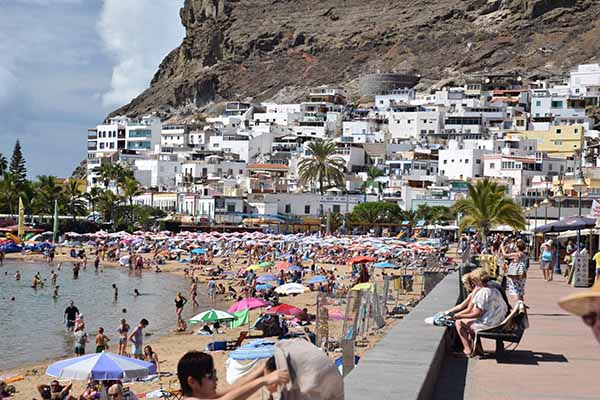 This concentration of tourism is both Gran Canaria's strength and its weakness. If you want a straightforward sunshine holiday, it is difficult to fault. There are thousands of accommodation options, restaurants catering for almost every nationality, excellent beaches and plenty of entertainment.
But some resorts can feel almost entirely detached from Spain. You can spend a fortnight in certain parts of Gran Canaria eating English breakfasts, drinking British beer and watching British television without having the slightest idea that you are actually in Spain. If that's what you want, fine — but it seems a terrible waste when there is such an interesting island outside the resort.
The island also has a lively nightlife scene, particularly around Playa del Inglés, where the famous Yumbo Centre has become a major entertainment and LGBTQ+ hub. There are bars and clubs for almost every taste, although the atmosphere can be considerably more lively than some holidaymakers might expect.
Gran Canaria isn't the prettiest Canary Island in every respect, and some of the southern developments are undeniably overbuilt. But judge the entire island by its tourist resorts and you are missing the point. The mountains, villages, volcanic landscapes, plantations and historic areas provide a remarkable contrast to the beaches.
Old Moaner verdict: Gran Canaria is far more interesting than its reputation suggests. Yes, there are resorts where you could quite easily forget which country you are in, and yes, some parts have been developed to within an inch of their lives. But get out and explore and the island becomes a completely different proposition. From the dunes of Maspalomas and the beaches of Las Palmas to Roque Nublo, the mountain villages and the winding roads through the interior, Gran Canaria offers considerably more than sunshine and sunbeds. Just don't spend the entire holiday beside the hotel pool — you'd be missing the best bits.
Return to Canary Islands Home Page